Learning objectives
- Describe the main phases of a newbuilding project, from contracting to delivery.
- Understand the structure and roles of a supervision site team.
- Manage the process of deviation from the contractual technical specification.
- Recognise the types of quality control points at the shipyard.
- Understand the typical milestone payment scheme.
- Manage the delivery phase and the post-delivery guarantee period.
The phases of a newbuilding project
Module objectiveDistinguish the industrial and contractual phases of a newbuilding from regulatory application triggers, checking each requirement under its own temporal clause.
There is no three-date test that applies identically to every requirement. Each rule must be checked under its own wording for contract, keel-laying or similar-stage, delivery, major-conversion and transitional triggers. A contract/keel/delivery summary is a project tool, not a universal regulatory definition.
Where a rule uses ‘keel laid or at a similar stage of construction’, actual keel laying is already the first case. Mass thresholds identify the alternative similar stage; they do not invalidate a keel actually laid.
A newbuilding project goes through distinct phases, from the definition of specifications to final delivery, each with its own challenges and its own degree of involvement by the future shipowner.
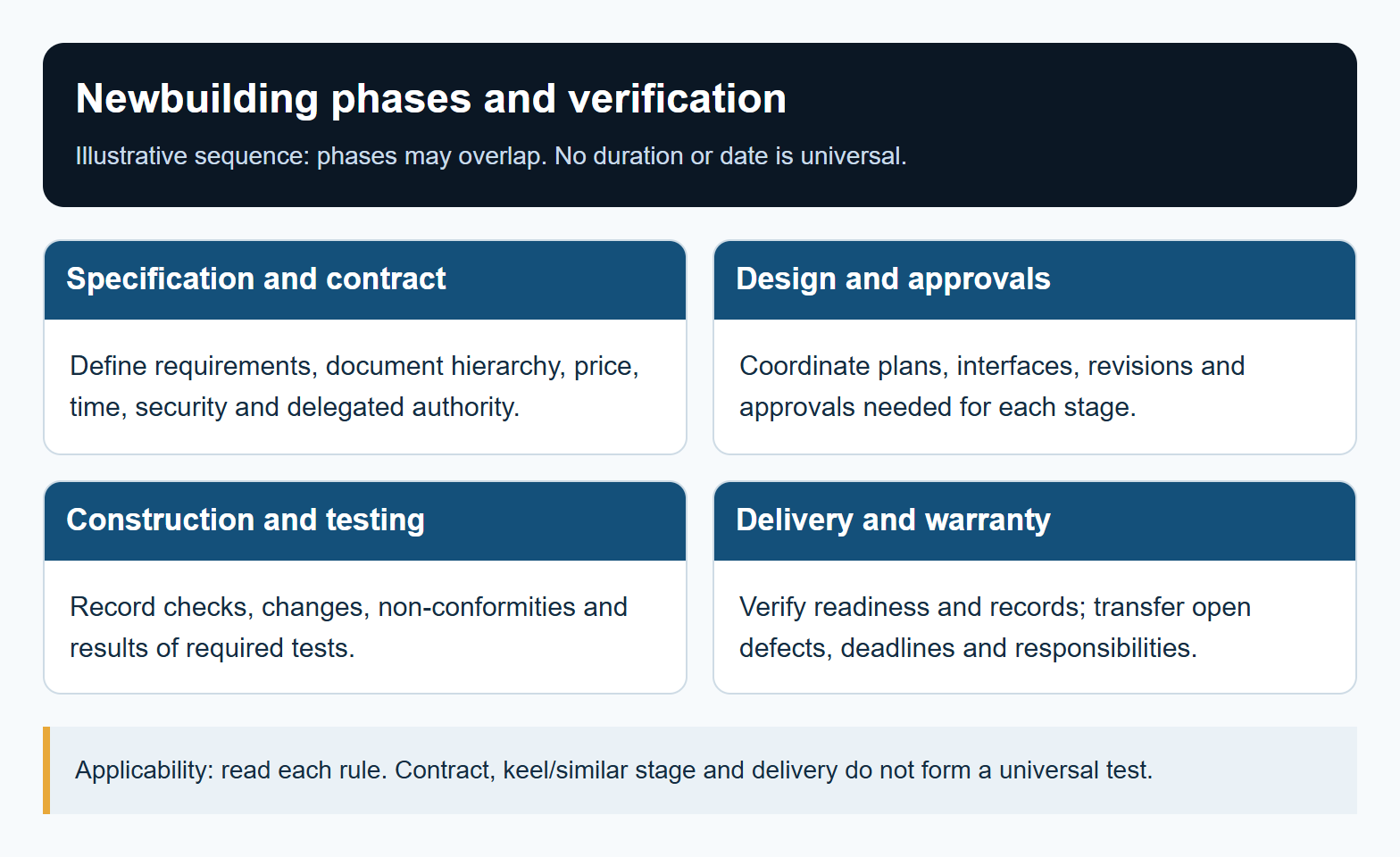
| Phase | Essential content |
|---|---|
| Specification and contracting | Definition of technical and commercial requirements; negotiation of the construction contract |
| Design | Development of the basic and then detailed design, with class approval |
| Construction | Steel cutting, block assembly, launching, outfitting |
| Trials and delivery | Sea trials, final verification, delivery of the ship to the owner |
Involvement of the future shipowner, through their own site team, should begin well before steel cutting: decisions made during the detailed design phase are the hardest and most costly to change once physical construction has begun.
Key takeaways
- Contract, keel and delivery are useful milestones, but not one universal regulatory test.
- Actual keel laying and a similar stage of construction are two cases within the definition, not the same threshold.
- The applicability matrix should record source, trigger, evidence, owner and decision.
The site team: structure and roles
Module objectiveDefine a supervision structure aligned with risks, phases and contractual mandate while keeping buyer, builder, class/RO and flag roles separate.
The site team represents the buyer within the contractual mandate and powers. Comments, acceptances or failure to object do not automatically transfer the builder's responsibility for design, materials and construction. The team performs neither class functions nor flag-State statutory powers.
Supervision combines attendance at critical points, document review, traceable records and, where accepted and appropriate to risk, remote tools. Remote methods extend coverage but do not replace access, testing or on-site judgement where required.
SUPERMAN 2025 is BIMCO's current form for a separate supervision engagement and must be read as actually agreed.
The site team is the group of supervisors sent by the shipowner to the shipyard to verify, throughout the construction period, that the ship is being built in compliance with the contractual specification and the expected quality standards.
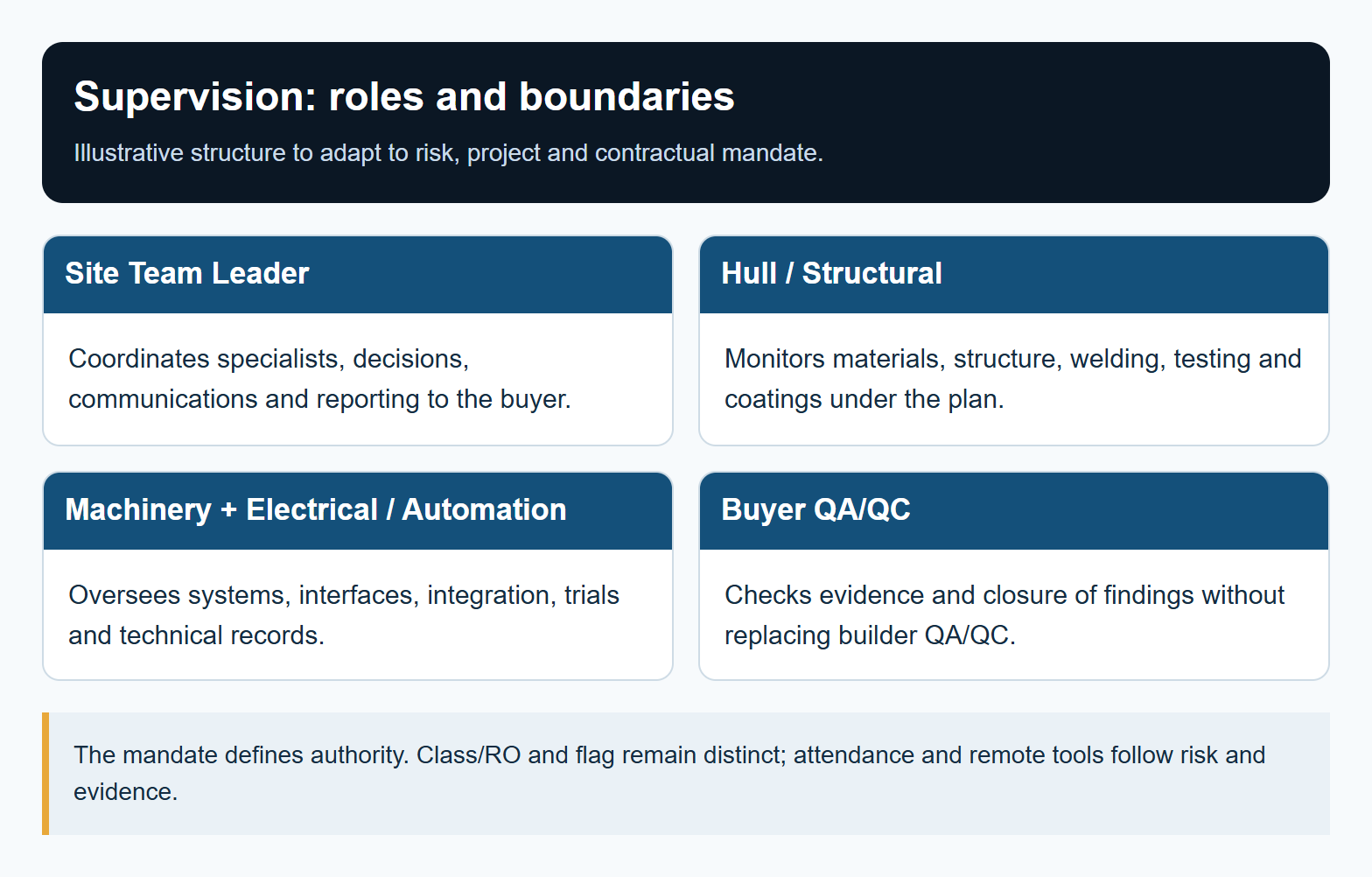
| Role | Area of responsibility |
|---|---|
| Site Team Leader | Overall team coordination and main interface with the shipyard and head office |
| Hull/Structural Supervisor | Structure, welding, hull integrity |
| Machinery Supervisor | Main engine, auxiliary systems, propulsion systems |
| Electrical/Automation Supervisor | Electrical systems, automation, control systems |
| QA/QC Inspector | Systematic verification of workmanship quality against agreed standards |
Key takeaways
- Site-team authority comes from the contract and formal delegations.
- Representative acceptance does not automatically transfer the builder's responsibility.
- Attendance, document review and remote tools should be combined according to risk and required evidence.
The contractual technical specification
Module objectiveTranslate operational, regulatory and commercial needs into a measurable, traceable specification aligned with the contract, class notation and acceptance criteria.
The technical specification defines the ship together with documents incorporated into the contract. Establish the hierarchy between contract, specification, general arrangement, drawings, maker list and class notation; applicable mandatory requirements cannot be removed by commercial agreement.
Each requirement should be verifiable: required performance, operating conditions, test method, tolerance, verification responsibility and consequences of deviation. Avoid terms such as “adequate” without agreed criteria. For example, guaranteed speed requires defined displacement, power, environmental conditions and correction method.
An ambiguous specification may create competing interpretations and disputes; it does not automatically favour either party. Record clarifications, revisions and approvals; check compatibility, maintenance, spares, accessibility and system interfaces before freezing the design.
Key takeaways
- A useful requirement defines performance, conditions, test method, tolerance and the effect of deviation.
- Specification, contract, maker list, drawings and class rules require an explicit document hierarchy.
- Ambiguous or aspirational wording creates variations, disputes and acceptance gaps.
Managing deviations from the specification
Module objectiveClassify and control variations, substitutions, non-conformities and rule changes while preserving authority, traceability and time, cost and warranty effects.
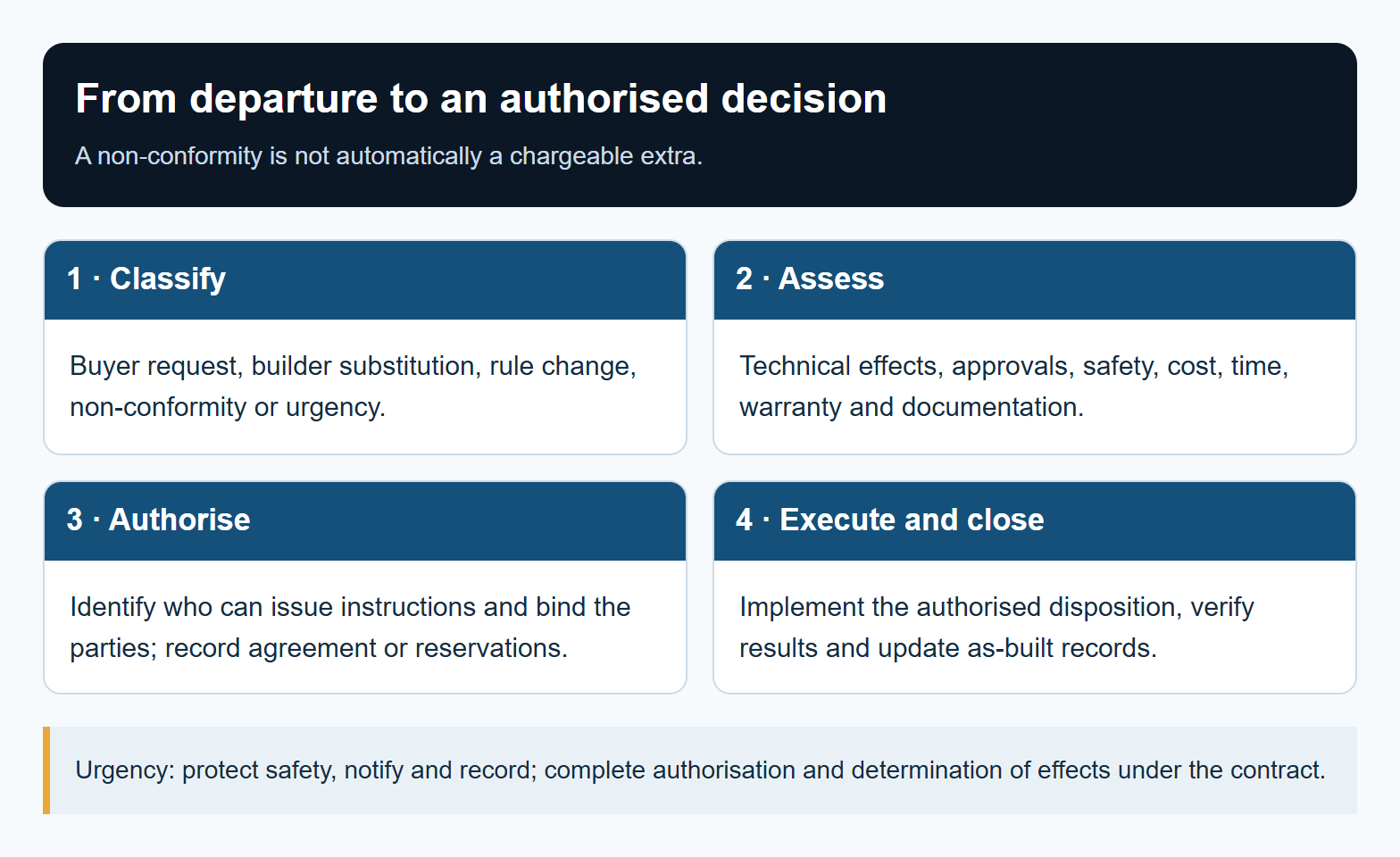
Each departure must be classified: buyer request, builder proposal or substitution, non-conformity, rule change, technical necessity or urgent measure. Classification determines authority, approvals and treatment of price, time, warranties and as-built records.
Written instruction and agreement or reservation of effects precede implementation where contract and circumstances permit. Urgency may precede the final VO but does not remove notice, records, mitigation and later determination. A site-team request is not by itself an authorised Variation Order.
Situations that require deviating from the original specification almost always arise during construction, for technical reasons, material availability or additional owner requests. Managing this process rigorously is essential for cost and schedule control.
Key takeaways
- A request is not a variation order, and not every departure originates with the buyer.
- Technical, class and statutory approvals do not replace commercial agreement.
- Urgency may precede the final document, but does not remove notice, records and determination.
Quality control at the shipyard
Module objectiveBuild a control plan coordinating builder QA/QC, buyer ITP and class survey without confusing their purposes or powers.
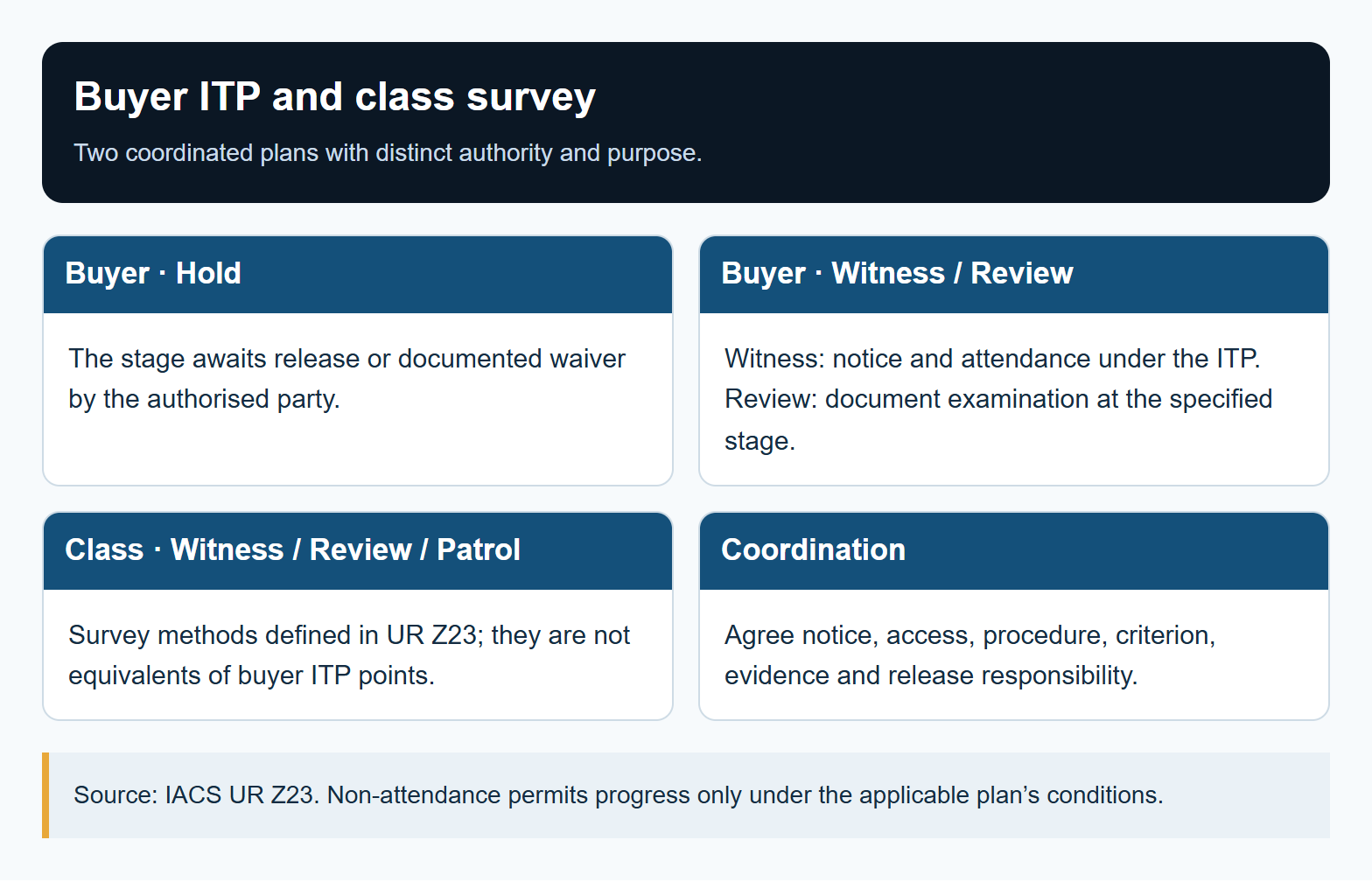
The builder’s Quality Plan, buyer’s Inspection and Test Plan (ITP) and class survey plan should be coordinated. Purpose, authority and acceptance criteria remain distinct. Buyer Hold, Witness and Review points do not map item by item to class Witness, Review and Patrol methods in UR Z23.
| ITP point | Rule to define |
|---|---|
| Hold | The stage does not proceed without release or documented waiver by the authority identified in the plan. |
| Witness | Notice and an opportunity to attend; proceeding without attendance is permitted only under the ITP conditions after the required notice. |
| Review | Document review at the stage specified in the plan, including before execution; it does not automatically indicate low-criticality work. |
For each check record drawing revision, procedure, criterion, notice, attendees, results and release. A non-conformity requires identification, containment, authorised disposition, any repair or rework and closure verification. Commercial acceptance cannot authorise departures from statutory or class requirements.
Key takeaways
- ITP Hold, Witness and Review points do not correspond to class Witness, Review and Patrol methods.
- Acceptance criterion, notice, evidence and release authority must be defined for each control.
- Quality is demonstrated by traceable records, not by inspector presence alone.
The construction contract and milestone payments
Module objectiveRead milestones and payments in the actual contract, linking each instalment to evidence, conditions precedent and applicable security.
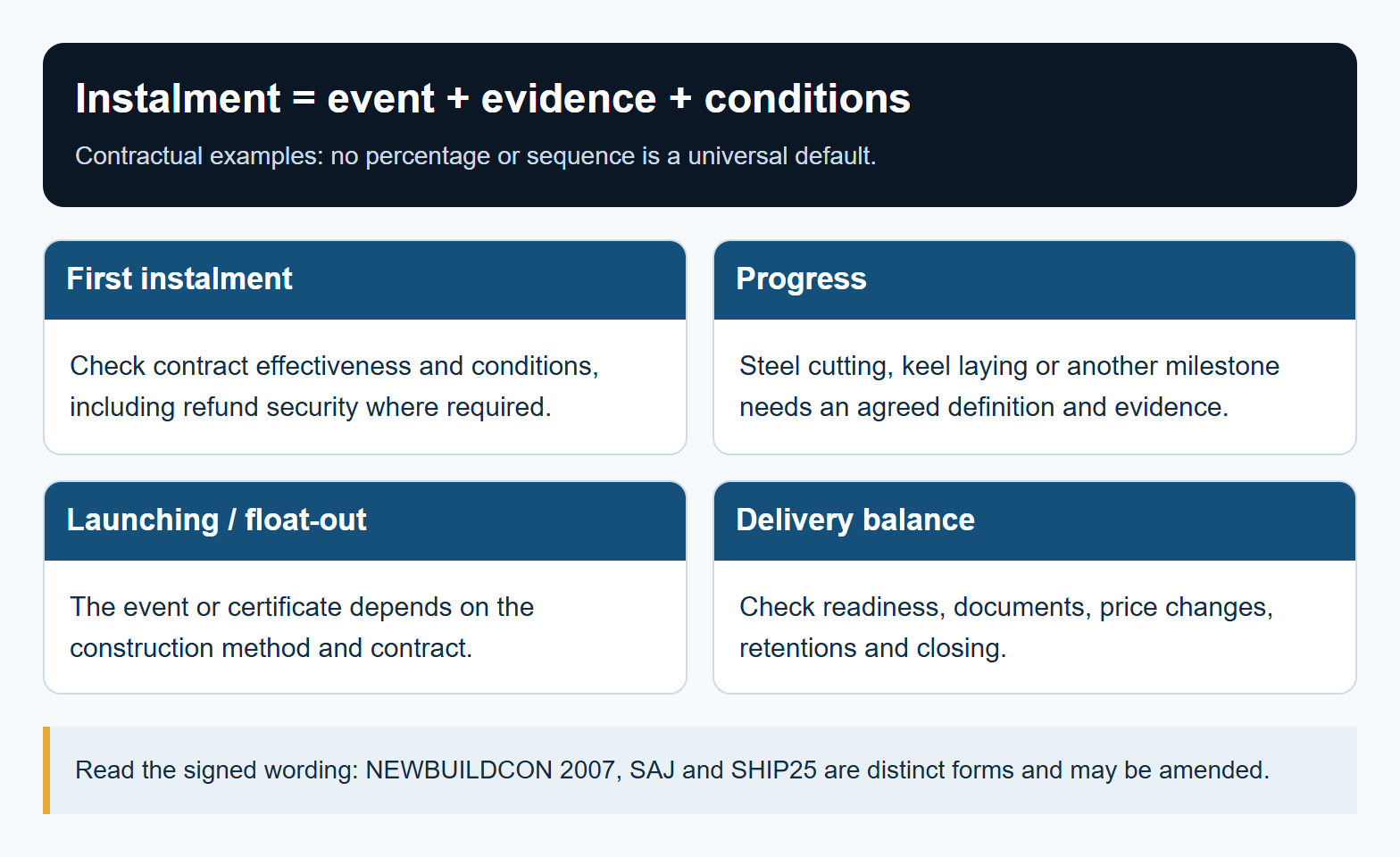
The contract links price and instalments to agreed events, documents and conditions. NEWBUILDCON 2007, the SAJ Form and SHIP25 (version 2026) are alternative starting points, normally amended; SUPERMAN 2025 concerns a separate supervision appointment. Percentages are not universal: number, sequence and evidence of milestones also come from the signed wording.
| Illustrative event | Evidence and condition to verify |
|---|---|
| Contract effectiveness / first instalment | Conditions precedent, any requirement for a compliant refund guarantee and specified documents. |
| Steel cutting | Contractual definition, ship identification and required confirmation. |
| Keel laying | Contract-defined progress event; assess any regulatory trigger separately. |
| Launching / float-out | Agreed construction method and progress certification; these are not identical events at every yard. |
| Delivery | Readiness, documents, any retention, final price adjustment and closing conditions. |
A provision using “keel laid or at a similar stage of construction” distinguishes actual keel laying from the similar stage. Under SOLAS II-1/1.2 the similar stage combines construction identifiable with a specific ship and assembly commencing with at least 50 t or 1% of the estimated mass of structural material, whichever is less. The threshold does not invalidate an actual keel laying; other chapters may use different definitions or paragraph numbers.
Before paying an instalment, verify that the required evidence exists and guarantees, dates and amounts remain aligned. A progress certificate alone does not demonstrate complete ship compliance and does not replace refund security.
Key takeaways
- NEWBUILDCON, SAJ and SHIP25 are alternative bases and are normally amended.
- Percentages and sequences are contractual; course graphics may only be examples.
- The refund guarantee must align with contract, instalments, expiry, demand and other transaction security.
The contract beyond the milestones: guarantees, delay, supplies
Module objectiveIdentify how security, delay, supplies, variations and remedies interact in the signed wording without moving defaults between forms.
Contract control needs a matrix of obligations, notices, deadlines, evidence and authority. The form’s name does not describe negotiated amendments. Identify governing law, arbitration venue and procedure, any expert determination and time limits in the contract; none is universal.
Protection of advance instalments
The refund guarantee governs repayment in the circumstances specified in its wording. Check issuer, beneficiary, amount, currency, effectiveness, expiry, demand formalities, conditions and interaction with disputes or arbitration. Not every guarantee is independent or payable on first demand; uniform terms cannot be inferred from the bank’s nationality.
Ownership of the ship under construction, any registration, risk and other security depend on contract and law. For every variation or extension, check whether guarantor consent or guarantee extension is needed before expiry. Protection may include other security and should be assessed as a whole.
Delay and remedies
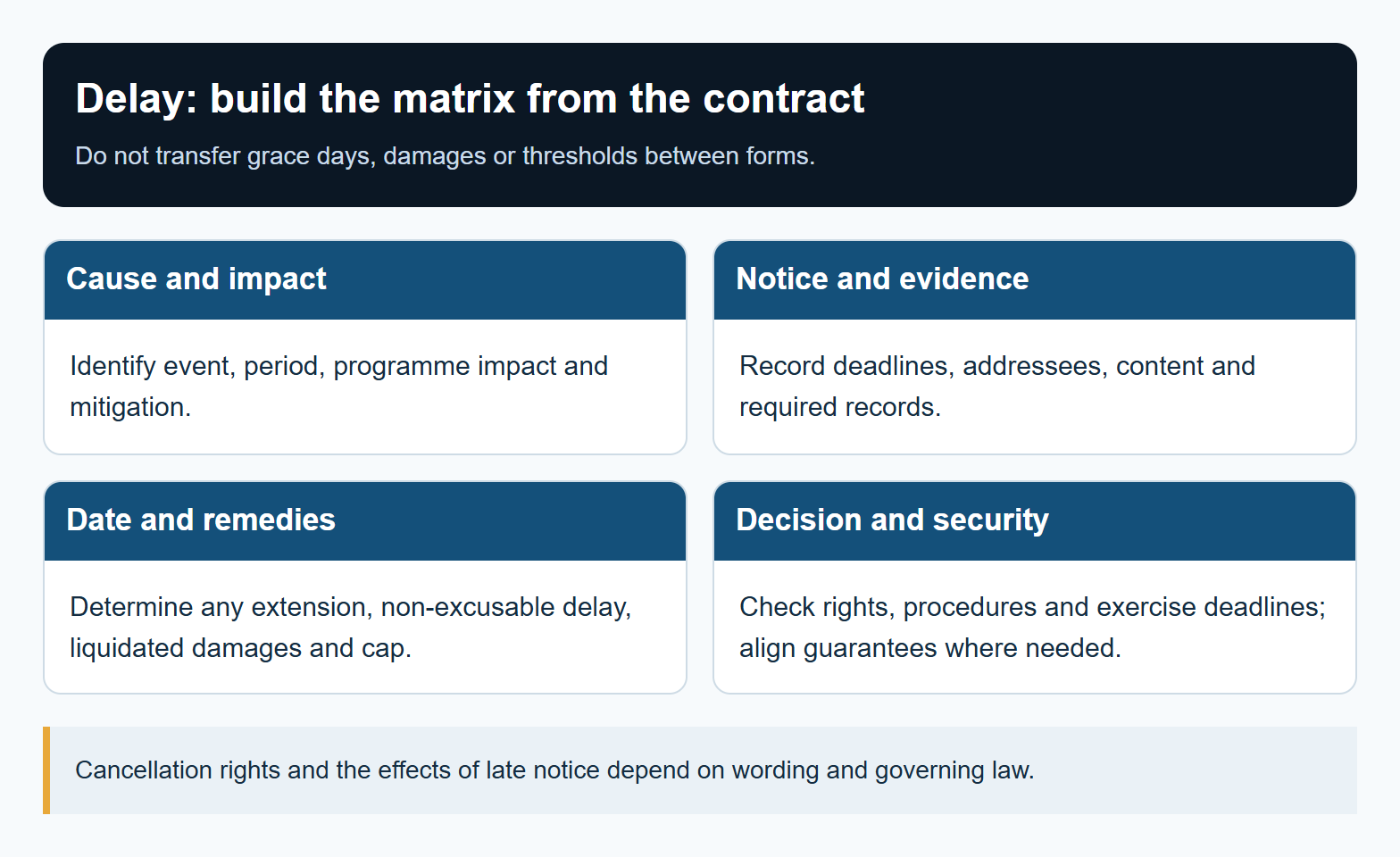
Distinguish contractually excusable delay, its effect on the delivery date and non-excusable delay. Document cause, duration, programme impact, mitigation and notices. Grace periods, liquidated damages, caps and cancellation rights are possible contractual mechanisms with their own thresholds and procedures. Crossing a threshold does not make every cancellation automatically valid.
The effect of late notice and the prevention principle depends on wording and governing law. The site team preserves facts and records and involves those with contractual authority; it should not assume “no notice, no extension” under every agreement.
Maker list and buyer’s supplies
The maker list identifies acceptable suppliers within agreed limits; specification, performance guarantees and approvals provide further control. For buyer’s supplies allocate design, purchasing, transport, custody, installation, integration, testing, warranty and delay risk. Buyer delay may generate time or cost relief only under applicable conditions and demonstrated impact, not automatically under every contract.
Key takeaways
- Permissible delay, notices, liquidated damages and cancellation form one clause system.
- Maker and buyer-supplied items require clearly allocated interfaces, responsibility, timing and warranty.
- Judgments interpret specific wording; they do not create identical conditions for every newbuilding.
The role of class in the newbuilding process
Module objectiveDistinguish classification, delegated statutory activity and contractual acceptance, using certificates, surveys and approvals correctly.
A classification society verifies its own rules. When authorised as a Recognized Organization it performs specified delegated statutory work. Both may occur at the same attendance but remain legally distinct.
A certificate of class is not a statutory certificate, and class attendance at sea trials does not approve every commercial guarantee. The buyer verifies guarantees under specification, protocol and contract.
Key takeaways
- Class applies its own rules; as an RO it performs only authorised statutory functions.
- The certificate of class and statutory certificates are distinct documents.
- Class attendance at a trial does not equal buyer acceptance of contractual guarantees.
Schedule plan approvals before the work they govern; coordinate surveys of materials, construction, integration and trials under class scope and statutory delegation. Maintain a register of comments, revisions, conditions and closure. Certificate issuance does not automatically remove buyer contractual reservations.
The rules the construction has to satisfy
Module objectiveApply GBS, PSPC, UR Z23 and quality standards within their precise scope, building verifiable evidence through delivery.
GBS and the Ship Construction File
SOLAS II-1/3-10 concerns oil tankers and bulk carriers of at least 150 m within its defined scope, including the exclusions for ore carriers and combination carriers. Triggers are a contract on or after 1 July 2016; in the absence of a contract, keel laying or similar stage on or after 1 July 2017; or delivery on or after 1 July 2020. The condition “in the absence of a contract” must not be omitted.
Goal-based Standards set structural goals verified through rules recognised as conforming to the IMO system. The Ship Construction File (SCF) records their implementation in design and construction: it must be provided at delivery and maintained throughout the ship’s life, with information available under SOLAS II-1/3-10 and MSC.1/Circ.1343. The IMO process includes subsequent verification, not only the historical 2016 outcome.
PSPC and the Coating Technical File
| Reference | Scope to check |
|---|---|
| MSC.215(82), SOLAS II-1/3-2 | Dedicated seawater ballast tanks of ships of at least 500 GT and double-side skin spaces of bulk carriers of at least 150 m: contract from 1 July 2008; in its absence, keel from 1 January 2009; or delivery from 1 July 2012. |
| MSC.288(87), SOLAS II-1/3-11 | Cargo oil tanks of crude oil tankers of at least 5,000 DWT: contract from 1 January 2013; in its absence, keel from 1 July 2013; or delivery from 1 January 2016. Check any alternative means allowed by the regulation. |
| MSC.244(83) | Recommendations for void spaces of bulk carriers and oil tankers; not a universal mandatory PSPC requirement. |
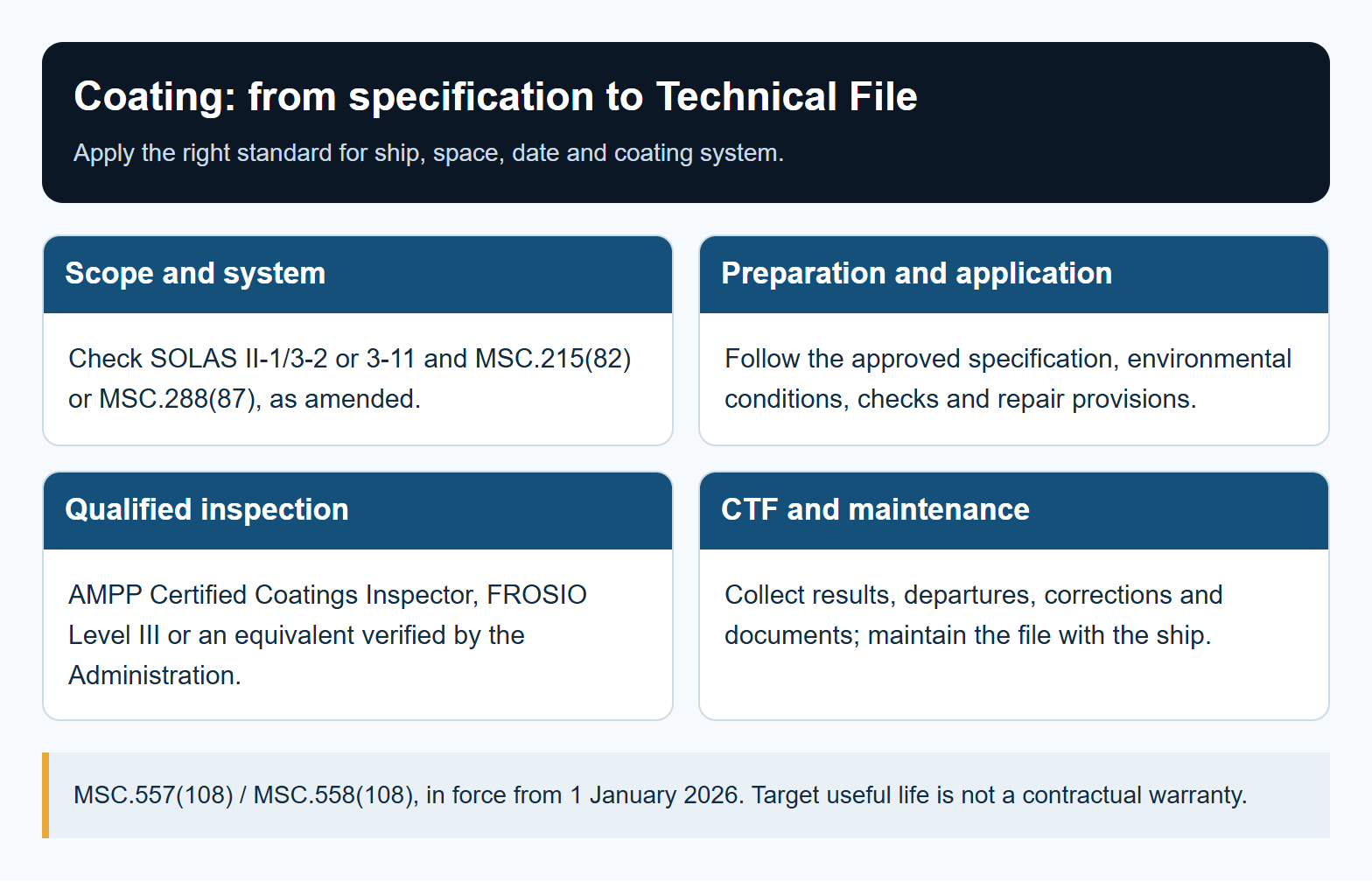
For the epoxy system in MSC.215(82), nominal dry film thickness is 320 μm with the 90/10 rule: at least 90% of readings reach nominal thickness and none falls below 90% of nominal. The 15-year useful life in GOOD condition is a design target, not a contractual guarantee. Preparation, salts, environmental conditions, stripe coats, application and repairs follow the applicable standard and approved system, including permitted exceptions; values do not transfer to every coating.
The Coating Technical File records specifications, application evidence, inspection and maintenance and stays with the ship. MSC.557(108) and MSC.558(108), in force from 1 January 2026, specify AMPP Certified Coatings Inspector, FROSIO Inspector Level III or an equivalent verified by the Administration. A change of name alone does not prove an earlier qualification invalid: check recognition and equivalence.
Hull survey and construction quality
IACS UR Z23 sets new-construction survey requirements within its scope. Recommendation 47 is a separate quality standard, applied as accepted or referenced by applicable rules and the project. Agree survey arrangements, critical stages, welding procedures, qualifications, non-destructive testing and tightness tests. Examination extent and acceptance of alternatives depend on applicable requirements: not every weld requires radiography, and survey alone does not replace builder QA/QC.
Key takeaways
- GBS and the Ship Construction File concern ships defined by SOLAS II-1/3-10, not every newbuilding.
- PSPC follows scope, construction date, Technical File and MSC.557/558(108) updates.
- UR Z23 and Recommendation 47 are distinct references and do not replace the contract or buyer ITP.
Sea trials and performance verification
Module objectivePlan repeatable trials and distinguish contractual results, class/statutory trials and final EEDI verification under current 2026 sources.
Plan trials before execution: approved programme, calibrated instruments, ship configuration, loading and environmental conditions, safety arrangements, stop and repeat criteria, corrections and data records. Distinguish factory acceptance tests, harbour tests, sea trials and integration tests; not all performance is measured at the same stage.
Contractual acceptance
Speed, consumption, deadweight and capacity are assessed against contract definitions. Engine-specific fuel consumption on a test bed is not the same as whole-ship daily fuel consumption. Tolerances, liquidated damages, caps, repeat trials, replacement and possible cancellation depend on the clauses; no three-step structure governs every guarantee. Preserve raw data, conditions, corrections and buyer reservations.
EEDI verification
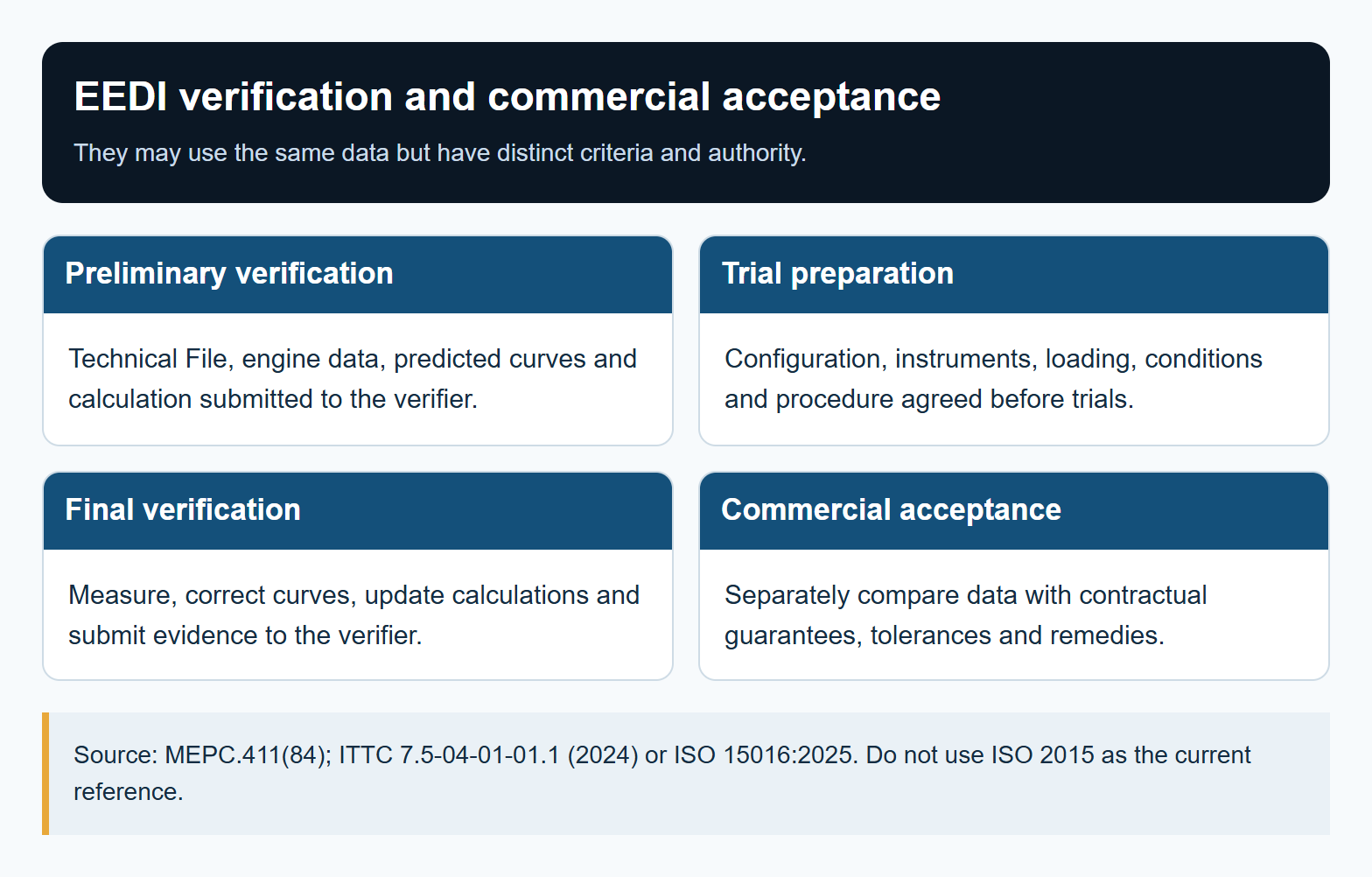
For ships in scope, MEPC.411(84) is the 2026 EEDI survey and certification guideline. Preliminary verification examines the Technical File, engine data and predicted curves; final verification uses trials and the as-built configuration, updates curves and calculation and requires verifier acceptance. The guideline references ITTC 7.5-04-01-01.1 (2024) or ISO 15016:2025 for measurement and analysis; ISO 15016:2015 appears only with the transitional end date of 1 May 2026.
EEDI verification and commercial performance acceptance may use the same data but have different authority, conditions and outcomes. Accepted contractual trials do not automatically demonstrate EEDI compliance.
Manoeuvrability
MSC.137(76) contains standards recommended to Administrations for ships constructed from 1 January 2004: length at least 100 m and chemical tankers/gas carriers regardless of length; high-speed craft are excluded. Check applicable implementation and modification cases. L is length between perpendiculars; V is in m/s in the L/V ratio. Tests refer to the standard’s conditions, not any loading or sea state.
| Trial | Criterion |
|---|---|
| Turning circle at maximum rudder | Advance ≤ 4.5 L and tactical diameter ≤ 5 L |
| Initial turning ability | With 10° of rudder, no more than 2.5 L travelled by the time the heading has changed by 10° |
| 10°/10° zig-zag | First overshoot ≤ 10° if L/V < 10 s, ≤ 20° if L/V ≥ 30 s, interpolated in between; second overshoot ≤ 25° and ≤ 40° at the same extremes |
| 20°/20° zig-zag | First overshoot ≤ 25° |
| Full astern stopping test | Track reach ≤ 15 L; the Administration may allow up to 20 L for ships of large displacement |
Key takeaways
- Protocol, instruments, conditions, corrections and acceptance criteria should be frozen before trials.
- MEPC.411(84) is the current EEDI guideline and refers to ITTC 2024 or ISO 15016:2025.
- The same data may support several checks, but purpose, authority and remedies remain separate.
Delivery of the ship
Module objectivePrepare a delivery-readiness matrix linking contractual conditions, records, certificates, title, financing, registration and applicable inventories.
The delivery readiness matrix should link every delivery condition to an owner, evidence, deadline and status. Technical acceptance, statutory compliance, payment and title transfer are not synonyms. Protocol, ownership, risk and possession follow contract, law and transaction structure; they do not necessarily pass on signature of one document.
| Document group | Required check |
|---|---|
| Protocol of Delivery and Acceptance | Acceptance, reservations, agreed timing and effects; consistency with closing and payment. |
| Builder’s Certificate / Bill of Sale | Title documents and form required by registry and law; both are not mandatory in every transaction. |
| Encumbrance and registration declarations | Freedom from liens, any deletion or non-registration and further evidence required by registry/lenders. |
| Class and statutory certificates | Relevant documents, validity, conditions and limitations; acceptability of interim documents checked with competent authorities. |
| Trials, inventories and technical records | Trial reports, manuals, as-built drawings, spares, equipment, configurations and controlled transfer of access. |
| Applicable SCF, CTF and IHM | Complete files, verified under their respective regimes and transferred with update responsibilities. |
For ships within the Hong Kong Convention, in force since 26 June 2025, IHM Part I is ship-specific, verified and accompanied by the required certification; a generic builder declaration is insufficient. EU Regulation 1257/2013 is a separate regime to assess against flag and activity.
Punch lists may contain findings of different severity. Accept any minor outstanding work only where permitted, identifying responsibility, deadline, closure method and contractual protection. Deficiencies preventing safety, certification or essential delivery conditions do not become acceptable merely by being listed. Transfer procedures, familiarisation and support for entry into service to the operating team.
Key takeaways
- Protocol, title, risk and possession follow the contract and transaction structure.
- The delivery dossier depends on ship, flag, class, registry, lenders and specification.
- For ships in scope, IHM Part I must be ship-specific, verified, certified and maintained.
The guarantee period
Module objectiveManage defects and warranty claims under the modified contract's definitions, time limits, notices, evidence, remedies and maker warranties.
Warranty follows the amended contract: check duration, commencement, any extension after repair, defect definition, notices, remedies, repair location, costs and exclusions. Design, materials and workmanship may be treated differently; do not exclude design in the abstract or assume a universal twelve-month period.
Maintain a defect register with discovery date, affected system, symptoms, impact, data and photographs, safety measures and notices sent. Notify through contractual channels and within deadlines as soon as the issue is identifiable; update evidence without waiting for the final deadline. Preserve components and data where needed, avoiding action that compromises safety or investigation.
Distinguish construction defects, wear, maintenance and misuse through investigation rather than premature attribution. Coordinate builder and maker warranties, integration responsibility, urgent repairs and approvals. A guarantee engineer, where provided or requested under the contract, assists within the mandate; attendance, status and costs depend on the actual clauses.
Handover from the site team to the technical office and crew should include open defects, deadlines, contacts and reserved rights. Close a claim only after evidence of resolution and functional verification; record costs and lessons learned.
Key takeaways
- Design cannot be excluded in the abstract: the contractual definition of Defect controls.
- Notify when the issue is identifiable rather than waiting for the final longstop.
- Repair, cost, downtime and exclusions depend on signed wording and connected guarantees.
Emerging trends
Module objectiveSeparate current requirements, adopted future measures and proposals still under negotiation, translating them into dated specification decisions.
Position at 15 September 2026
The IMO Net-Zero Framework remains under negotiation: ISWG-GHG 22 (1–4 September 2026) continued considering proposals without adoption. Assumptions about future costs and dates must be labelled as scenarios, while EEDI, EEXI, CII and regional regimes continue within their respective scopes. A ship ordered today may be affected by future rules according to the triggers eventually adopted.
North-East Atlantic: separate the dates
MEPC.407(84) provides for entry into force on 1 September 2027, subject to MARPOL acceptance. The area’s SOx/PM limit applies from 1 September 2028 because of the initial twelve-month exemption in regulation 14.7. For NOx Tier III, read amended regulation 13: contract from 1 January 2027; in the absence of a contract, keel/similar stage from 1 July 2027; or delivery from 1 January 2031. These are construction triggers, not three area activation dates. Check engines in scope, exceptions and operation in the ECA after entry into force.
Alternative fuels and digital systems
For ships in IGF scope, natural gas has prescriptive provisions in Part A-1. For other solutions establish the applicable approval route with the flag, including general IGF provisions, alternative design where required and fuel-specific guidance: MSC.1/Circ.1621 for alcohols and IMO guidance for ammonia and hydrogen, with developments approved at MSC 111. Do not confuse fuel use with carriage as cargo, where the IGC Code may apply.
HAZID and HAZOP support risk assessment but do not replace approval or the entire demonstration of equivalence. The specification should allocate analysis, interfaces, tests, ventilation, detection, emergency shutdown, maintenance and training. A planned date for future rules is not an existing mandatory deadline.
Design cyber resilience from the outset: check IACS E26/E27 Rev.1 for ships in scope contracted from 1 July 2024, alongside flag requirements and SMS risk management. Assign responsibility for inventory, supplier access, IT/OT integration, testing, backups and delivery records.
Key takeaways
- Net-Zero Framework not adopted at 15 September 2026; separate future scenarios from current requirements.
- North-East Atlantic ECA: scheduled entry into force September 2027, SOx/PM September 2028; specific NOx triggers.
- Alternative fuels and cyber require defined approval routes, tests and competence.
Building a successful project
Module objectiveIntegrate governance, applicability, technical control, contract administration and evidence into a decision system usable from project start through warranty.
Project governance should link requirement, authority, owner, evidence, deadline and impact. Technical acceptance, class/statutory approval and commercial acceptance are not synonyms; close-out also transfers open risks, lessons learned and responsibilities into operation and warranty.
A successful newbuilding project integrates technical competence, contractual rigour and management of the relationship with the shipyard in a balance that must be built from the very start of the project.
Critical success factors
Applied example: the yard proposes a pump outside the maker list to avoid delay. The site team records the proposal and checks performance, interfaces, spares, warranty and required approvals. A substitution may be technically acceptable without commercial authorisation. The delegated decision-maker agrees or reserves price and time effects; after instruction, drawings, tests and inventories are updated. If the pump does not meet specification, the non-conformity does not automatically become a buyer-funded extra.
An excessively confrontational site team risks damaging the collaboration needed to effectively resolve the problems that inevitably arise in a complex project. The right balance is between firmness on standards and constructive collaboration in problem-solving.
Key takeaways
- A decision matrix should identify requirement, authority, owner, evidence, deadline and impact.
- Technical acceptance, class/statutory approval and commercial acceptance are not synonyms.
- Close-out transfers not only documents but open risks, lessons learned and responsibilities into operation and warranty.
Recurring mistakes
From the Mistake Library of SuperbaKnowledge, filtered to the subjects this course covers. This view selects and organises content published in SuperbaKnowledge; it does not modify or replace it. The linked Knowledge page remains the reference version, while official texts remain authoritative.
| Topic | Mistake | Typical consequence | Topic sheet |
|---|---|---|---|
| Coating and PSPC (Performance Standard for Protective Coatings) | Coating applied under out-of-specification environmental conditions (excessive humidity, unsuitable temperature) | Compromised coating adhesion, premature failure | See the topic sheet |
Glossary of terms
| Term | Definition |
|---|---|
| Delivery | Handover of the ship to the shipowner |
| Hold Point | A control point that suspends work until approval |
| Keel laying | A construction event that may be a regulatory trigger where the applicable provision uses it; it must be distinguished from the similar stage defined by the rule. |
| Launching | The launching of the ship |
| Punch list | List of minor deficiencies not yet resolved |
| Sea trials | Sea trials to verify performance |
| Site team | The shipowner's supervision team at the shipyard |
| Steel cutting | Cutting of the first steel plate, the physical start of construction |
| Variation Order (VO) | Document formalising a change to the contractual specification |
| ITP | Inspection and Test Plan |
| RO | Recognized Organization |
| GBS | Goal-based Standards |
| SCF | Ship Construction File |
| CTF | Coating Technical File |
| IHM | Inventory of Hazardous Materials |
| FAT | Factory Acceptance Test |
| NCR | Non-Conformity Report |
| EEDI | Energy Efficiency Design Index |
References and sources
Sources and references for the review of 15 September 2026. Applying a commercial clause requires the signed contract and its amendments; cited forms do not establish universal terms.
This course is educational material for training purposes and does not constitute a professional certification or qualifying credential. Read the full disclaimer.