Learning objectives
- Frame the superintendent's role within the ship management organisation and manage its key interfaces (DPA, crewing, HSEQ, procurement, commercial).
- Manage the relationship with the «Flag–Class–Port State» triangle and plan the survey and statutory certification cycle.
- Design and supervise a dry-dock campaign, from specification to post-dock, controlling time, cost and quality.
- Prepare the ship and crew for PSC inspections and a SIRE 2.0 vetting inspection, managing observations and rectification plans.
- Build, monitor and analyse a vessel's OPEX budget, identifying cost drivers and control levers.
- Apply the decarbonisation framework (EEXI, CII, IMO Net-Zero Framework, EU ETS, FuelEU) to fleet management decisions.
- Conduct a structured incident/near-miss investigation with root cause analysis and effective closure of corrective actions.
- Manage the first hours of a casualty: notifications, preservation of evidence, interface with H&M, P&I and class.
The role of the Marine Superintendent
Module objectivePosition the Marine Superintendent within a ship-management organisation, distinguish it from adjacent shore-based roles and identify its principal interfaces.
The Marine Superintendent is a shore role whose scope is defined by the company. Marine duties typically concern navigation, cargo and operational safety; technical duties concern machinery, maintenance and dry-docking. These roles may be combined but are not synonyms for Fleet Manager. This course covers their interfaces: actual duties and authority must be checked against the SMS, organisation chart and management agreement.
Technical, Marine and Fleet Superintendent: scopes compared
Titles vary from company to company. In structured organisations, the typical distinction is as follows:
| Role | Main focus | Typical interfaces |
|---|---|---|
| Technical Superintendent | Engine room, maintenance, class, dry-dock, technical budget | Chief Engineer, class, yards, procurement |
| Marine Superintendent | Deck, navigation, operational safety, cargo, nautical audit | Master, HSEQ, terminals, vetting |
| Fleet Manager | Coordination of multiple superintendents, fleet performance, client | Management, owner, DPA, commercial |
| DPA (for comparison) | SMS link between ship and top management; direct access to top management; monitoring and support, according to the authorities defined in the SMS | Top management, Master, RO/flag |
In many lean companies, a single person combines the roles of Technical and Marine Superintendent. The course uses «Superintendent» in a broad sense, noting where the marine or technical scope makes a difference.
Position within the organisation
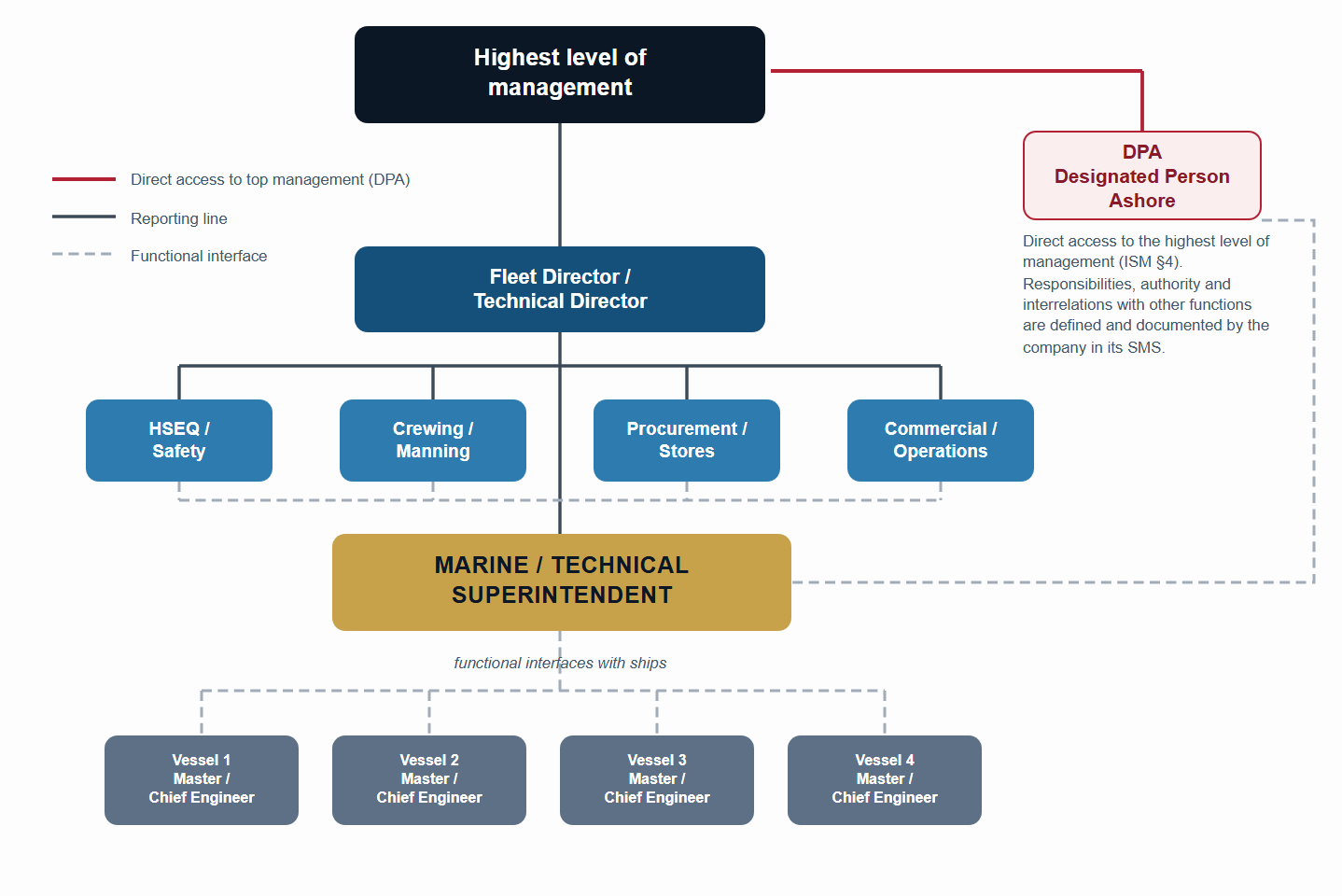
In a typical organisational configuration, the Marine/Technical Superintendent may report to the Fleet or Technical Director and maintains functional interfaces with other shore functions and the assigned ships. The ISM Code does not prescribe this organisation chart: responsibilities, authority, interrelations and lines of communication must be defined and documented in the company’s Safety Management System.
The DPA has direct access to the highest level of management (ISM Code, §4). The Code does not establish a predefined hierarchical relationship between the DPA and the Superintendent: authority and interrelations depend on the organisation documented by the company, without limiting the DPA’s direct access to top management.
On board, the Master retains overriding authority and responsibility to make the decisions necessary for safety and pollution prevention and to request the company’s assistance when required (ISM Code, §5.2).
IMO explains that the Code is expressed in broad terms because companies, organisational structures and operating conditions may differ. Official IMO page on the ISM Code ↗
Span of control: how many ships?
The number of ships a superintendent can manage (span of control) depends on vessel type, age, operating area and technical complexity. An excessive workload is a well-known latent factor in accidents: it reduces time on board and the quality of oversight. An example of how to frame it, to be defined on the fleet profile:
| Segment | Relative span | Notes |
|---|---|---|
| Tanker / gas / chemical | narrower span | High vetting and maintenance intensity, narrower span |
| Container / Ro-Ro | intermediate span | System complexity, fast turnarounds |
| Dry bulk / general cargo | wider span | Simpler systems, wider span |
| Older ships (>15 years) | −1 relative to segment | Higher maintenance and class workload |
Superintendent KPIs
Role performance is measured on a balanced scorecard across safety, technical and economic dimensions. A good KPI set avoids rewarding cost savings at the expense of safety:
| Area | KPI | Company threshold — to be defined |
|---|---|---|
| Safety | LTIF (Lost Time Injury Frequency, lost-time injuries per 106 hours worked); near-misses per ship/month | LTIF threshold and expected near-miss threshold |
| Class | Overdue surveys; open Conditions of Class | 0 overdue; CoCs closed on time |
| PSC | Deficiencies per inspection; detention rate | Deficiency-per-inspection threshold; no detentions |
| Vetting | SIRE observations per inspection; rejection rate | Downward trend; 0 commercial rejections |
| Maintenance | PMS overdue jobs; critical spares availability | Overdue threshold; critical spares availability threshold |
| Economics | OPEX variance vs budget; off-hire days | ± contained variance; minimal off-hire |
| Environment | CII rating; consumption vs baseline | Rating C or better; downward trend |
Every euro «saved» by postponing maintenance or reducing critical spares creates a technical debt that comes back, amplified, as off-hire, detention or an accident. The mature superintendent defends the safety budget against commercial pressure and documents decisions: traceability is their first professional and legal protection.
Verification sources: ISM Code, §§1.1.10, 3–5, 9–10, 12–14 ↗
Key takeaways
- The title and perimeter of the role vary between organisations: Technical, Marine and Fleet Superintendent are not synonyms.
- Technical and nautical responsibilities may overlap: what counts is the actual organisation chart, not the label.
- The role connects company policy with the real operational condition of the fleet.
International regulatory architecture
Module objectiveNavigate the hierarchy between IMO conventions, class rules and flag legislation, and know which certificate is at stake in any decision.
The ship lives within a network of international conventions, mandatory codes, class rules and flag legislation. The superintendent must move confidently through this hierarchy to know, in every decision, «who has the final say» and which certificate is at stake.
Key international conventions
| Instrument | Subject | Relevance for the Superintendent |
|---|---|---|
| SOLAS 1974 | Safety of life at sea; structure, systems, life-saving, fire safety | Basis of almost all statutory certificates; chapters IX (ISM) and XI-2 (ISPS) |
| MARPOL 73/78 | Pollution prevention (Annexes I–VI) | IOPP, IAPP, EEXI/CII (Annex VI), waste and discharge management |
| ISM Code | Safety management (SMS) | Company DOC and ship SMC; the heart of the role |
| ISPS Code | Ship and port security | SSP, CSO/SSO, ISSC |
| MLC 2006 | Maritime labour, crew welfare | MLC Certificate + DMLC I/II; growing PSC inspections |
| STCW 78 (Manila) | Training, certification, watchkeeping | Manning, endorsements, hours of rest |
| Load Lines 66 | Freeboard, watertight integrity | ILLC; assignment conditions |
| COLREG 72 | Rules for preventing collisions | Nautical audits, bridge procedures |
| Tonnage 69 | Gross/net tonnage | Basis for taxes, fees, regulatory thresholds (e.g. 5,000 GT) |
| BWM 2004 | Ballast water management | BWMC, treatment systems; for ships subject to the Convention, the transitional timetable towards D-2 was generally completed by 8 September 2024, subject to applicable exceptions, exemptions and equivalences; commissioning testing of the system |
| AFS 2001 | Anti-fouling systems | IAFS Certificate; cybutryne ban |
| Hong Kong 2009 (in force since 26.6.2025) | Safe recycling of ships | IHM maintained on board; Ready for Recycling Certificate at end of life |
The Flag – Class – Port State triangle
Three different parties oversee the ship's compliance, with distinct roles the superintendent must keep separate:
- Flag Administration (Flag State): holder of sovereignty over the ship; issues or authorises statutory certificates and sets national requirements. Often delegates verifications to a Recognized Organization.
- Classification society / RO: verifies compliance with its own class rules (structure, machinery) and, as an RO, carries out statutory verifications on behalf of the flag. Issues the class certificate.
- Port State Control (PSC): the port State inspects foreign ships to verify compliance with conventions; can detain the ship (detention). It does not «manage» the ship: it controls it.
Class and statutory status are distinct tracks that often run together (the same RO handles both) but answer to different masters: class to its own rules, statutory to the flag. A Condition of Class is not a PSC deficiency, and vice versa: confusing the two leads to wrong decisions on priorities and deadlines.
The MLC is an ILO convention, not an IMO convention. Each instrument depends on ship type, tonnage, voyages, dates and flag State: this list does not require every certificate on every ship. An RO acts only within flag authorisation; the Administration retains oversight responsibility.
Verification sources: ISM Code, §§1.1.10, 3–5, 9–10, 12–14 ↗ · Hong Kong Convention, Art. 3; Reg. 5 ↗
Key takeaways
- SOLAS, MARPOL, ISM, ISPS, MLC and STCW underpin almost every statutory certificate.
- The Flag–Class–Port State triangle assigns distinct roles: who issues, who verifies by delegation, who inspects in port.
- Knowing who has the final word prevents treating requirements of different natures as equivalent.
ISM Code and Safety Management System leadership
Module objectiveRecognise the structure of the ISM Code, the relationship between DOC and SMC, and the cycle of non-conformity, corrective action and Management of Change.
The ISM Code (SOLAS Ch. IX) has been mandatory since 1998 for the first categories and since 2002 for the further categories specified by SOLAS IX. It requires every company to have a documented and verified Safety Management System (SMS). In practice, the superintendent is the main «engine» of the SMS at ship level: feeding it, verifying it and improving it.
Structure of the Code
The Code is organised into functional elements that define responsibilities, procedures and improvement cycles. Operational summary:
| § | Element | What the Superintendent oversees |
|---|---|---|
| 1 | General provisions, objectives, definitions | Understands the scope and purpose of the SMS |
| 2 | Safety and environmental policy | Keeps it alive on board, not just a poster |
| 3 | Company responsibility and authority | Organisation chart, delegations, resources |
| 4 | Designated Person (DPA) | Cooperates with the DPA; respects their autonomy |
| 5 | Master's responsibility and authority | Supports the Master's authority, does not erode it |
| 6 | Resources and personnel | Manning, familiarisation, competence |
| 7 | Shipboard operations | Procedures for critical operations |
| 8 | Emergency preparedness | Drills, scenarios, joint exercises |
| 9 | Non-conformities, accidents, near-misses | Reporting, analysis, corrective actions |
| 10 | Maintenance of ship and equipment | PMS, critical equipment, critical spares |
| 11 | Documentation | Document and record control |
| 12 | Verification, review, evaluation | Internal audits and management review |
DOC and SMC
The Document of Compliance (DOC) certifies the company's system for the ship types it manages; the Safety Management Certificate (SMC) certifies the individual ship. The DOC must be verified annually; the SMC has a five-year cycle with an intermediate verification. The superintendent monitors deadlines and verifications: an expired SMC commercially immobilises the ship.
| Certificate | Subject | Verification cycle |
|---|---|---|
| DOC | Company system (per ship type) | 5-year issue; annual verification |
| Copy of DOC on board | Proof the company holds a valid DOC | Must be present on board |
| SMC | SMS of the individual ship | 5-year issue; 1 intermediate verification (between 2nd and 3rd year) |
Non-conformities, corrective actions and Management of Change
The SMS virtuous cycle is: detection (audit, inspection, near-miss) → root cause analysis → corrective action → effectiveness verification. The superintendent must distinguish correction (putting out the fire) from corrective action (preventing recurrence), avoiding a formal «patch-up» closure that leaves the root cause intact.
- Non-conformity (NC): deviation from requirements. A major NC that seriously threatens safety or the environment can lead to withdrawal/suspension of the certificate.
- Corrective action (CAPA): addresses the cause; its effectiveness must be verified over time, not just its implementation.
- Management of Change (MoC): every change to equipment, procedures, crew or operations must be assessed for the risks it introduces before being implemented. It is the weakest link most often found in real systems.
Few near-miss reports may reflect low exposure or under-reporting: the count alone proves neither safety nor fear of reporting. Assess report quality, activities and trust in the system. Heinrich/Bird pyramids are teaching models, not universal numerical ratios or predictors of major accidents; also examine high-potential events and critical barriers.
Under ISM, a major non-conformity also includes lack of effective and systematic implementation of a requirement (§1.1.10), not only an immediate threat. Ordinary DOCs and SMCs last at most five years: DOC annual verification is within ±3 months of the anniversary; an SMC requires at least one intermediate verification, between its second and third anniversaries if only one is conducted. Interim certificates follow §14. Internal audits on board and ashore must be no more than 12 months apart, with at most three additional months in exceptional circumstances (§12.1), not a routine extension.
Verification sources: ISM Code, §§1.1.10, 3–5, 9–10, 12–14 ↗
Key takeaways
- The DOC certifies the company and the SMC the individual ship: one does not substitute for the other.
- The SMS lives on evidence: recorded non-conformities, corrective action on the cause and verification of effectiveness.
- Management of Change is the safeguard against modifications introduced without risk assessment.
Advanced technical management and maintenance
Module objectiveChoose between the four maintenance strategies according to equipment criticality, and govern the PMS, critical systems and the spares policy that follows.
Maintenance is the economic and safety heart of technical management. The superintendent does not «repair»: they design and govern a maintenance strategy that keeps the ship reliable, compliant and available at the lowest life-cycle cost.
The four maintenance strategies
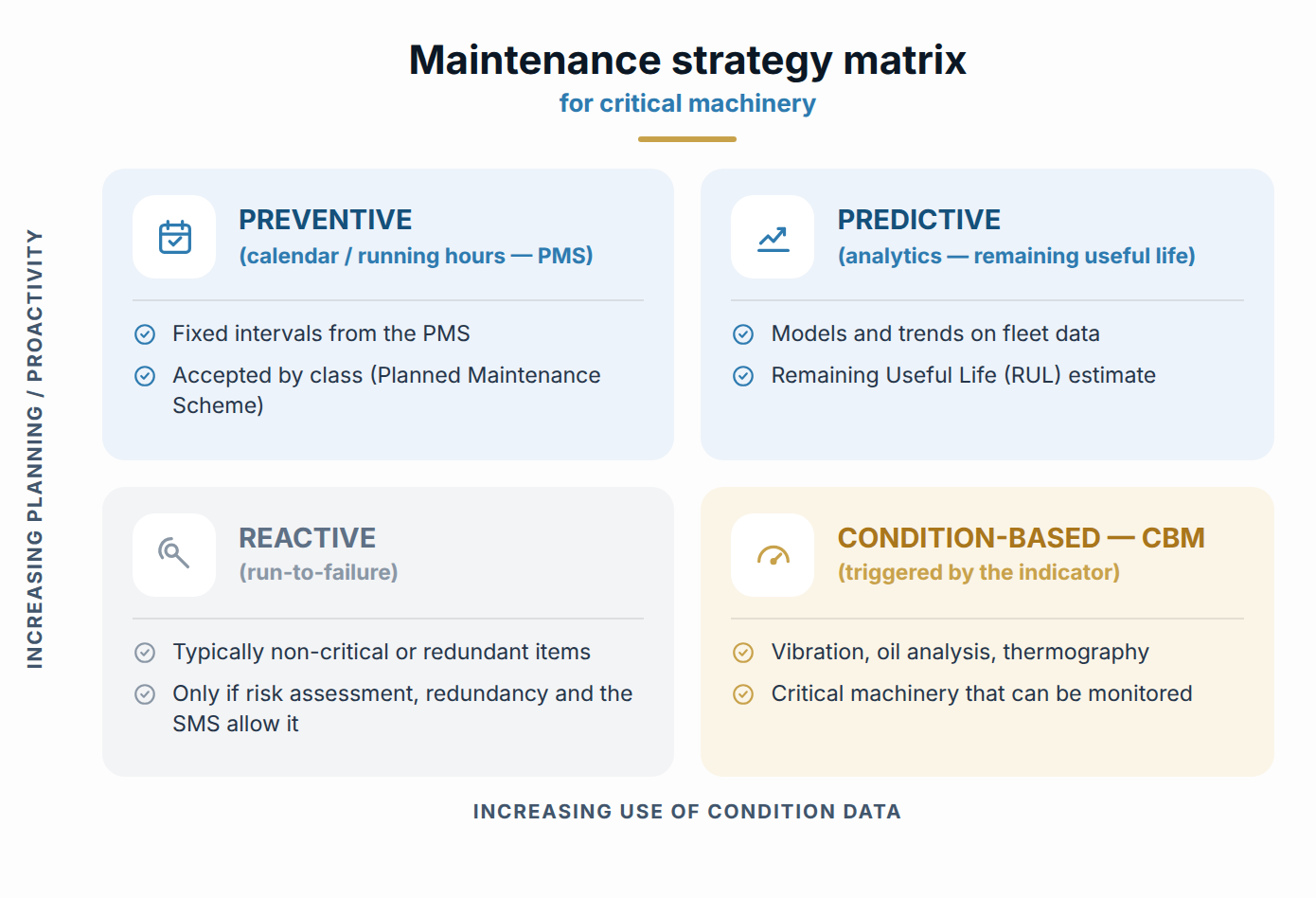
No strategy is «the best» in absolute terms: the choice depends on the criticality of the equipment, redundancy and the availability of condition data.
| Strategy | Principle | When to use it |
|---|---|---|
| Reactive (run-to-failure) | Action taken on failure | Only where risk assessment, redundancy and the SMS allow it |
| Preventive (time-based) | Fixed intervals (hours/calendar) from the PMS | Standard on board, accepted by class |
| Condition-based (CBM) | Action triggered by indicators (vibration, oil, thermography) | Monitorable critical machinery |
| Predictive (analytics) | Models and trends estimating remaining life | Fleets with sensors and data platforms |
Planned Maintenance System (PMS)
The PMS organises maintenance tasks, due dates and records within the SMS. A class-approved PMS scheme may change how specified machinery is surveyed under the society’s rules; it does not automatically replace class or statutory surveys. The superintendent checks coverage, overdue tasks, evidence and spares.
Critical equipment and critical spares
The ISM Code (§10.3) requires identifying equipment and technical systems whose sudden failure could create hazardous situations, and taking specific measures to promote their reliability, including regular testing of stand-by arrangements and equipment not in continuous use. On that basis the company defines in its own SMS and PMS which critical spares to keep on board or readily available: the list follows from risk assessment, redundancy, makers' instructions and class rules, not from the text of the Code. The availability of critical spares is a safety KPI, not just a logistical one.
MTBF (Mean Time Between Failures): average time between failures; measures the reliability of a component.
Availability: the proportion of time the equipment is ready for use; target close to 100% for critical systems.
Maintenance backlog: all outstanding maintenance work; overdue tasks are the subset past their due date. Measure volume, criticality and age separately.
Verification sources: ISM Code, §§1.1.10, 3–5, 9–10, 12–14 ↗ · IACS, III 5/INF.27; PR35 ↗
Key takeaways
- No strategy is best in absolute terms: reactive, preventive, condition-based and predictive are chosen by criticality and redundancy.
- The PMS plans and records maintenance within the SMS; an approved scheme does not automatically replace surveys.
- The ISM Code requires identifying critical systems and promoting their reliability; the company defines the critical spares in its own SMS.
Class and survey management
Module objectivePlan statutory and class surveys by certificate and interpret Conditions of Class and Recommendations under the applicable rules.
The ship maintains class and statutory certificates through a cycle of surveys. Managing this cycle — anticipating windows and requirements — avoids class suspensions and commercial downtime. It is a distinctive competence of the technical superintendent.
The harmonised regime (HSSC)
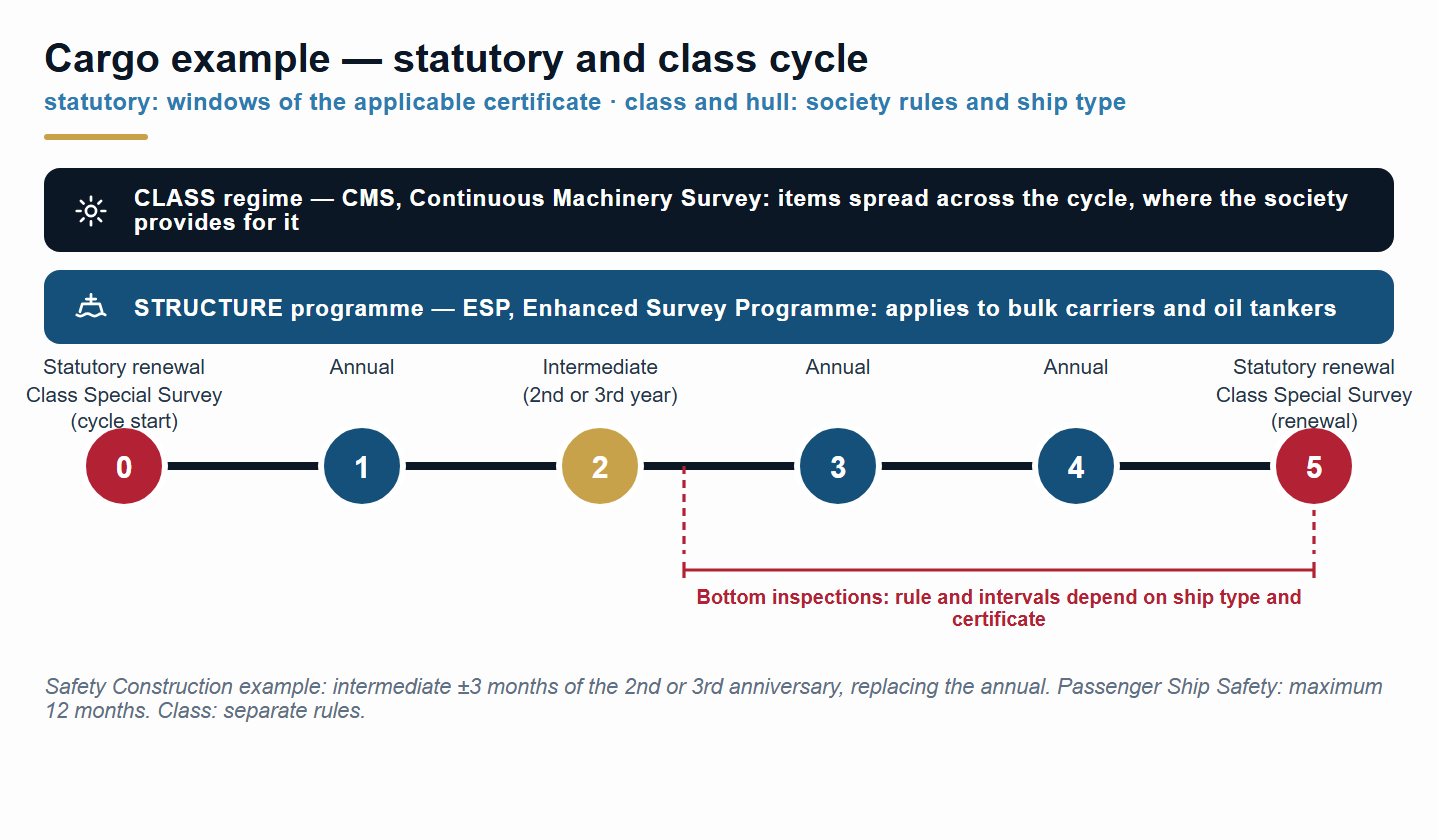
HSSC harmonises statutory surveys and certification; many cargo-ship certificates have a maximum five-year duration. The Passenger Ship Safety Certificate instead has a maximum 12-month duration. Annual, intermediate and periodical surveys depend on the certificate. The class cycle (Special Survey, annuals, CMS) remains separate, although it can be coordinated with statutory surveys.
| Regime | Survey | Content | Periodicity |
|---|---|---|---|
| Statutory (HSSC) | Annual | General verification of certificate validity | Every year, within the window of the applicable certificate |
| Statutory (HSSC) | Intermediate | In-depth review according to certificate and ship type | For Safety Construction: ±3 months of the 2nd or 3rd anniversary; check the certificate |
| Statutory (HSSC) | Renewal | Renewal of the statutory certificate | At most 5 years for many cargo certificates; Passenger Ship Safety: at most 12 months |
| Class | Class annual | General verification under the society rules | Every year, society window |
| Class | Special Survey | Full class renewal, often in dry-dock | Every 5 years |
| Class | CMS | Continuous Machinery Survey: rotating machinery, where the society provides for it | Items spread across the five-year cycle |
| Hull | Bottom / docking inspection | Hull and underwater inspection | Rule and intervals depend on ship type, age and applicable certificate; for many ships two inspections in the cycle |
| Structure | ESP | Enhanced Survey Programme: applies to bulk carriers and oil tankers | Overlaid on the cycle, under the ESP programme |
Conditions of Class and Recommendations
A Condition of Class requires work or verification by a deadline to maintain class. Recommendation may be the equivalent term used by a society for that same requirement: it must not automatically be treated as optional. Remarks and memoranda are interpreted under applicable rules. Record the requirement, deadline and formal closure; effects of suspension on certificates, insurance and chartering require checks with the flag, insurers and contract.
The golden rule is to plan the five-year cycle backwards from the Special Survey: fix the dry-dock and Special windows first, then build intermediates, annuals and CMS around them. Those who chase deadlines one by one end up paying for unplanned downtime and full-price yard slots.
Verification sources: A.1207(34), HSSC 2025, §§3–5 ↗ · IACS, III 5/INF.27; PR35 ↗
Key takeaways
- Many cargo certificates follow a maximum five-year cycle; the passenger safety certificate lasts at most 12 months.
- Annual, Intermediate and Special surveys differ in content and window: anticipating them avoids commercial downtime.
- Recommendation may mean Condition of Class: check the requirement and meet its deadline.
Dry-dock management
Module objectiveSet up a dry-dock campaign as a project: critical path, repair specification, tendering, yard supervision and post-dock closure.
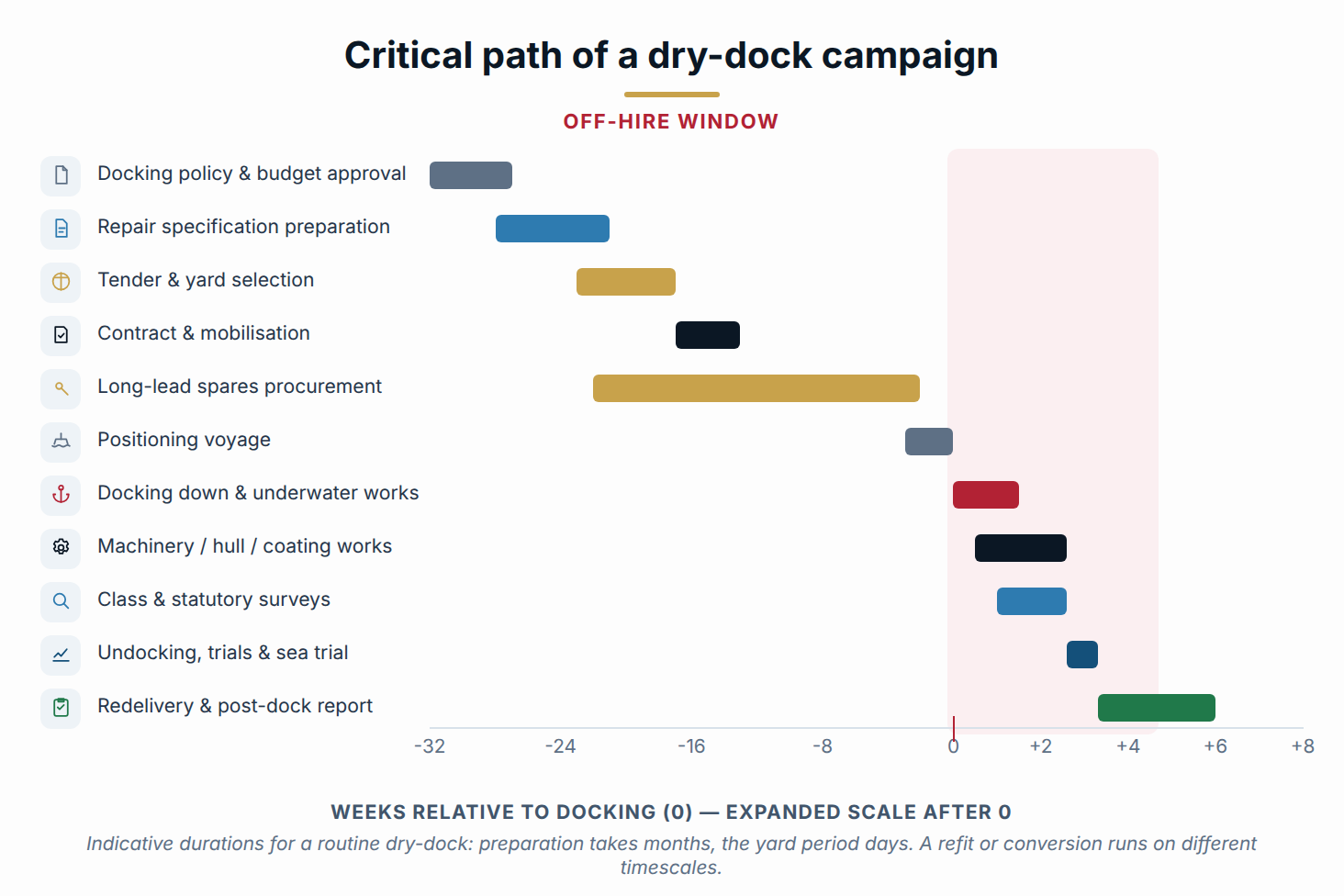
Dry-docking is a significant project in terms of cost, downtime and safety. It needs a budget, schedule, suppliers and risk controls proportionate to the work; it is not necessarily the most expensive event in a ship’s life.
The project's critical path
A well-managed dry-dock starts months before entering the dock. Long lead-time activities (spares, yard selection) must start well in advance so as not to become the bottleneck.
Preparing the specification and tender
The repair specification is the contractual document that describes every job in detail, quantity and standard. An ambiguous specification is the leading cause of extra costs at the yard. Yard selection balances price, location, technical capability, availability and reputation.
| Yard selection criterion | What to assess | Typical weight |
|---|---|---|
| Price and terms | Quotation, dock days, growth work rate | High |
| Location | Deviation from route, positioning off-hire | High |
| Technical capability | Suitable dock, competencies, subcontracting | High |
| Slot availability | Compatibility with class window | Medium |
| Track record / QHSE | History, safety, environment | Medium |
| Guarantees and payment | Milestones, guarantees, penalties | Medium |
Site control and post-dock
During the works, the superintendent (or the site team) oversees progress, quality, safety and, above all, growth work: additional jobs that emerge in the dock, which must be approved in writing with an agreed price before execution. The post-dock report closes the project: final cost/time reconciliation, lessons learned, warranties to activate.
For additional work, agree and record scope, price or valuation basis, schedule impact and approving authority in writing. A safety emergency may require immediate action under the SMS and contract: make safe, notify and document promptly without waiting for price negotiations.
Before work: coordinate ship and yard on energy isolation, permits, enclosed spaces, hot work, stability and simultaneous operations. Before return to service: complete functional tests, required class/flag checks, permit closure and documented acceptance. Price agreement does not replace these checks.
Key takeaways
- A dry-dock is prepared months in advance: long lead-time items set the critical path.
- An ambiguous repair specification can generate cost overruns and disputes.
- Yard selection balances price, location, capacity and availability, not price alone.
Port State Control
Module objectiveUnderstand how the MoUs select ships for inspection and what turns a deficiency into a detention.
Port State Control is the system by which port States inspect foreign ships to enforce international conventions. A detention costs off-hire, reputation and charterers' attention. The superintendent works to ensure PSC inspections close without detainable deficiencies.
The MoUs and regional regimes
Paris MoU and Tokyo MoU coordinate regional regimes; the USCG operates a separate regime. Flag lists, RO assessments and company performance are not the same ranking: use the methodology, period and criteria of the relevant regime.
Ship Risk Profile and targeting
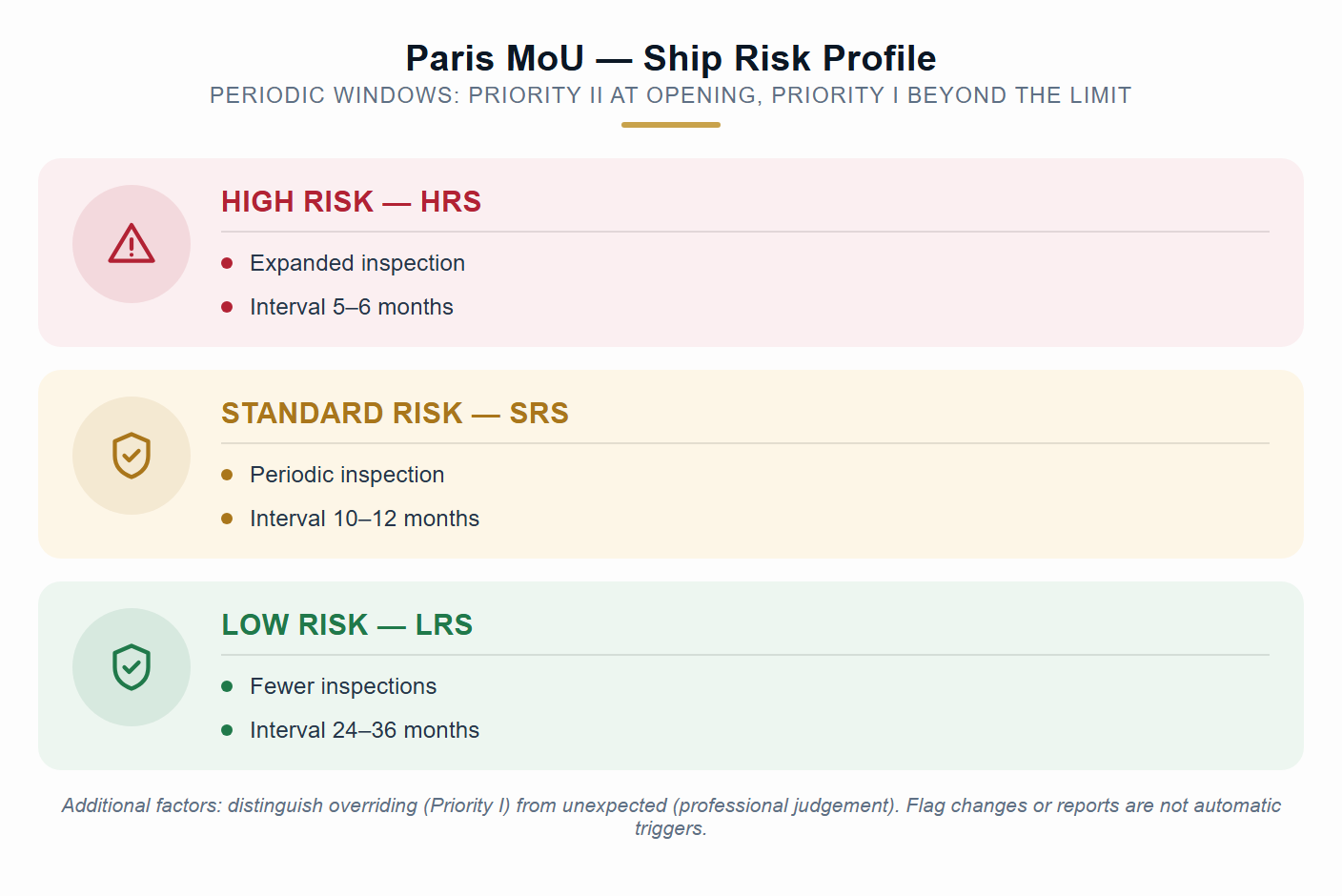
Within Paris MoU, the HRS/SRS/LRS profile contributes to selection. Periodic windows are 5–6, 10–12 and 24–36 months: the ship becomes eligible (Priority II) at the opening and Priority I beyond the limit. Overriding and unexpected factors may trigger earlier inspections with different levels of obligation. Inspection type also depends on category, age, clear grounds and circumstances; the profile alone does not describe the whole process.
Deficiencies and detention
Deficiencies are classified by severity; some require rectification before departure, others within a set period, and the most serious result in detention. Recurring detention areas include fire safety, life-saving appliances, ISM («systemic» deficiencies revealing a purely formal SMS), MLC and the engine room.
| Action code | Meaning | Operational implication |
|---|---|---|
| 15 — rectify at next port | Deficiency deferred to the next call | Rectify at the next port under PSC instructions |
| 16 — rectify within 14 days | Non-urgent rectification; maximum 14 days | Rectify as soon as necessary and reasonable; follow the instructions received |
| 17 — rectify before departure | Deficiency to be resolved in port | Rectify before departure; code alone does not decide detention |
| 21 — company ISM corrective action within 3 months | Item 15150: also final action after the audit required by code 19 | Company action on the ship–shore system; unexpected factor after 3 months |
| 19 — flag State audit before departure | Detainable ISM deficiency | Flag/authorised-RO audit; release remains a PSC decision |
| 46 — rectify at agreed repair port | Detainable deficiency with an authorised transfer | After the ETA at the repair yard an unexpected factor is triggered |
Table 7.1 — Paris MoU PSC action codes, extract (PSCC59/2026/03, Annex 1; each regime uses its own coding). Detention has no numeric code: it is recorded with the «Grounds for detention» tick box alongside the deficiency.
A broken light is an isolated deficiency; an ISM deficiency signals that the system is not working and attracts stricter inspections (an ISM-related detention often triggers a supplementary company audit). Preparing the ship for PSC mainly means keeping the real SMS alive, not polishing the ship the night before.
Distinguish the deficiency code, action code and detention indication. Detention and release are decisions of the PSC authority: a flag or authorised-RO audit alone does not permit departure. The decision also considers the combined effect of deficiencies and voyage conditions.
Verification sources: Paris MoU, Annexes 7–9 ↗ · PSCC59/2026/03, Annex 1 ↗
Key takeaways
- Paris MoU, Tokyo MoU and the autonomous USCG regime apply different targeting criteria.
- The Ship Risk Profile combines generic parameters, inspection history and the performance of flag, RO and company.
- The difference between a deficiency and a detainable deficiency lies in severity and immediacy of risk, not in number.
Vetting and SIRE 2.0
Module objectiveRecognise what changes with SIRE 2.0 and how vetting and TMSA determine commercial access to the tanker market.
In the tanker world (oil, chemical, gas) access to chartering runs through vetting: oil major companies assess a ship's suitability before entrusting it with cargo. The central tool is OCIMF's SIRE programme. A ship that is not «vettable» is, in practice, commercially excluded from that market.
SIRE 2.0: the new regime
Since 2 September 2024 SIRE 2.0 is the OCIMF programme that replaced VIQ7. It is not an incremental update: it generates a CVIQ tailored to the ship and combines different question types, response tools, evidence and observations, with greater attention to human and organisational factors.
| SIRE 2.0 element | What changes for the ship and crew |
|---|---|
| Dynamic questionnaire (CVIQ) | Each inspection generates a set of questions tailored to the ship: no more «learned by heart» answers |
| Tablet-based inspection | Photographic evidence and observations recorded in real time in the digital record |
| Differentiated response tools | Each response tool has its own scale: depending on the question it may be binary or graded |
| Programme dimensions | Hardware, procedures and human factors, according to the applicable question |
| Performance Influencing Factors | A set of human/organisational factors assessed through interaction with the crew |
| Focus on real competence | The crew must demonstrate operational competence, not memorised answers |
The vetting ecosystem and TMSA
SIRE does not exist in isolation. TMSA (Tanker Management and Self Assessment) is the tool with which the company self-assesses and improves its management system by element (KPIs and best practices at progressive levels). For chemical tankers there is also the CDI scheme. The superintendent oversees both the outcome of individual inspections and the system maturity measured by TMSA.
With SIRE 2.0, preparation changes in nature: you no longer «train to answer», you build real competence and consistency between procedures, hardware and behaviour. Internal pre-vetting (a simulated internal inspection) remains the best tool, but it should be aimed at verifying that the crew can actually perform, not repeat. Observations should be closed with traceable actions, not justifications.
SIRE 2.0 provides inspection information: it does not issue an OCIMF pass/fail or universal commercial approval. Each recipient makes its own vetting decision. Hardware, procedures and human factors are programme dimensions, not necessarily three assessments in every question. Operator comments and actions do not automatically erase observations from the report.
Verification sources: OCIMF, SIRE 2.0 ↗
Key takeaways
- Since 2 September 2024 SIRE 2.0 is the OCIMF programme that replaced VIQ7.
- The dynamic CVIQ generates ship-specific questions: memorised answers no longer work.
- TMSA is the company’s self-assessment and vetting assesses the ship: the two levels support each other.
OPEX budgeting and cost control
Module objectiveBuild and monitor an OPEX budget, recognise its cost drivers and carry out variance analysis.
The superintendent oversees the OPEX items assigned under company delegations. Managing OPEX means building a realistic budget, monitoring variances and acting on cost drivers without compromising safety and compliance.
The structure of OPEX
Daily OPEX (often expressed as cost per day) groups together recurring management items. The breakdown varies by ship type and flag, but crew costs are almost always the dominant item:
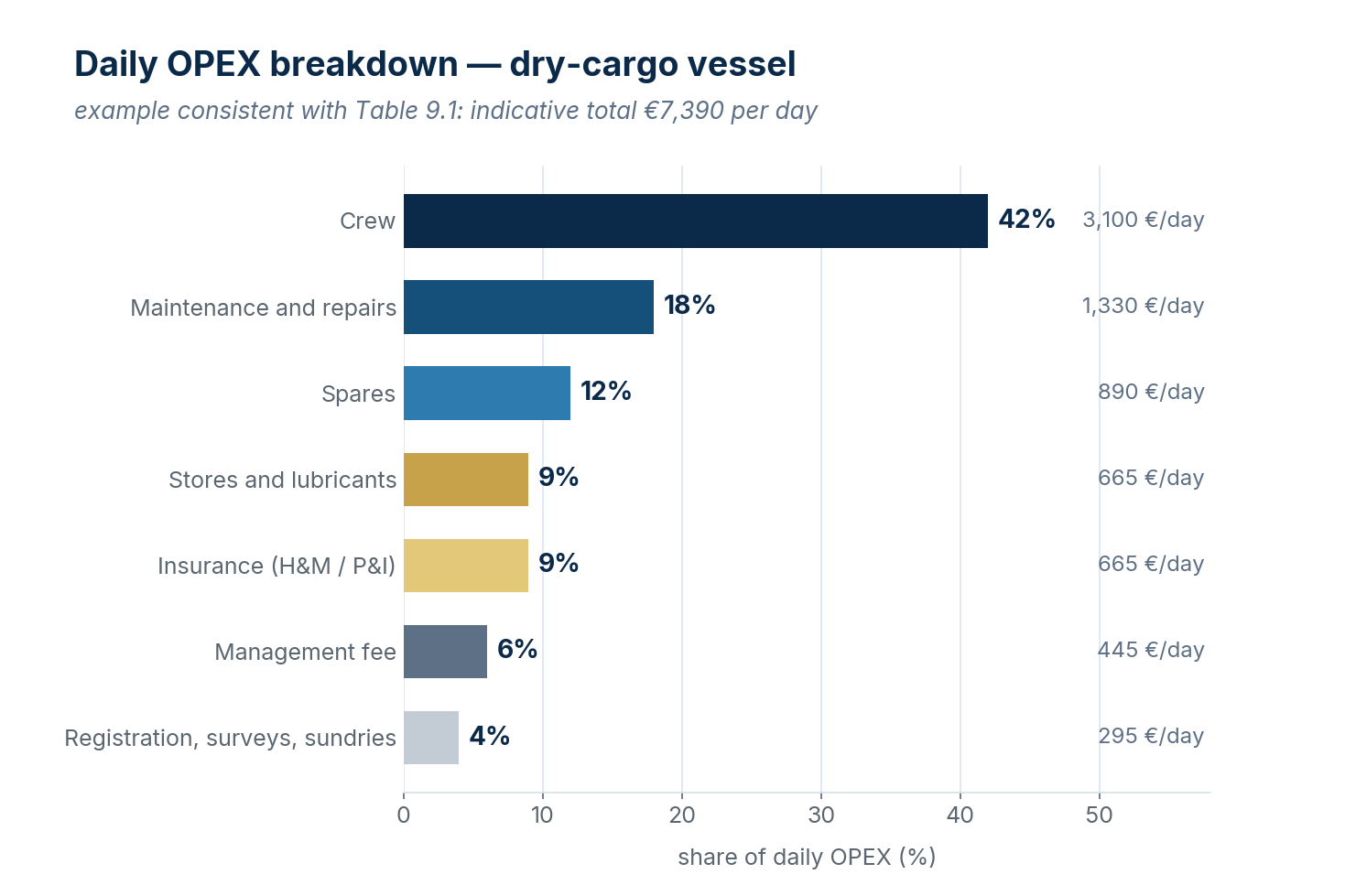
Budget cycle and variance analysis
The typical cycle: annual budget (bottom-up from the ship + top-down from the company) → monthly/quarterly monitoring → variance analysis → updated forecast → review. Variance analysis distinguishes causes (price, volume, timing) to avoid wrong conclusions.
| Item | Budget (€/day) | Actual (€/day) | Reading the variance |
|---|---|---|---|
| Crew | 3,100 | 3,250 | Currency change / overtime: monitor |
| Maintenance and repairs | 1,330 | 1,680 | Unplanned failure: check the causes |
| Spares | 890 | 780 | Purchase timing: possible slippage |
| Stores and lubricants | 665 | 690 | In line |
| Insurance (H&M / P&I) | 665 | 665 | Fixed contractual |
| Management fee | 445 | 445 | Fixed contractual |
| Registration, surveys, sundries | 295 | 320 | Unplanned additional survey |
| Total (indicative) | 7,390 | 7,830 | +6.0%: driven by unscheduled maintenance |
A budget trimmed to please management only produces negative variances and eroded credibility. Better a defensible budget with explicit assumptions (ship age, class plan, dry-dock in the period) and a contingency reserve. The variance should be explained by its cause, not hidden: transparency builds trust and freedom of action.
Budget responsibility follows company delegations. This OPEX example excludes voyage fuel, port costs, financing and investments; dry-docking and major maintenance follow the accounting policy. The total is €7,390 → €7,830/day: +440, or +5.95%. Maintenance is the largest variance (+350), but attribution to a failure requires evidence and cannot be inferred from numbers alone.
Key takeaways
- Crew is almost always the dominant item in daily OPEX.
- The cycle runs from annual budget through monitoring, variance analysis, updated forecast and review.
- Separating the causes of a variance — price, volume, timing — prevents wrong conclusions.
Decarbonisation and environmental compliance
Module objectiveDistinguish applicable EEXI/CII, EU ETS and FuelEU requirements from parameters still proposed in the Net-Zero Framework.
The superintendent distinguishes applicable requirements, adopted rules with future effective dates and proposals. This review is dated 14 September 2026; before operational decisions check the ship, voyage, competent authority and official version.
Starting point: EEXI and CII
Two instruments already in force stem from MARPOL Annex VI: the EEXI (Energy Efficiency Existing Ship Index), a technical requirement on the design efficiency of the existing ship; and the CII (Carbon Intensity Indicator), an annual operational indicator that assigns the ship a rating from A to E based on actual carbon intensity, with a reduction line that tightens over time.
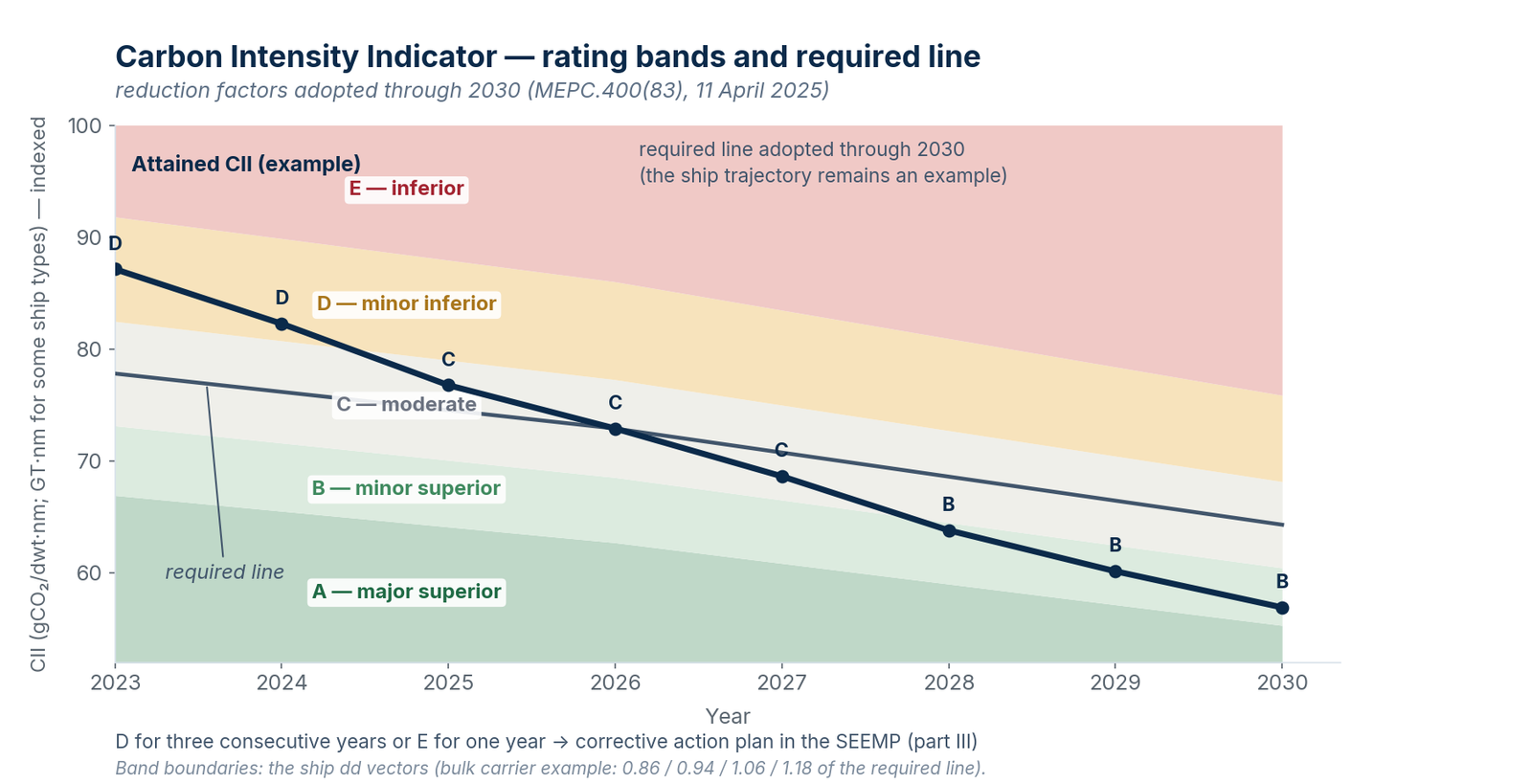
A ship rated D for three consecutive years, or E for one year, must submit a plan of corrective actions in the SEEMP (Ship Energy Efficiency Management Plan), part III. The superintendent monitors the rating during the year and activates operational levers in good time (speed, trim, hull cleaning, energy efficiency).
The reduction factors against the 2019 reference line are adopted up to 2030: −5% in 2023, −7% in 2024, −9% in 2025, −11% in 2026 and, by resolution MEPC.400(83) of 11 April 2025, −13.625% in 2027, −16.250% in 2028, −18.875% in 2029, −21.500% in 2030. The second phase of the CII and SEEMP review, started at MEPC 84 and due to be completed by 2028, continues and may change the picture, but it does not make already adopted values undetermined. In the chart above it is the ship trajectory that is illustrative, not the required line.
The leap: the IMO Net-Zero Framework
MEPC 83 (April 2025) approved a draft IMO Net-Zero Framework with a GFI standard and global economic mechanism. The approved text covers ships of 5,000 GT and above, with exclusions: it is not yet an obligation in force.
The framework has two elements: a GHG Fuel Intensity standard (GFI) that progressively reduces the carbon intensity of fuel, and a pricing mechanism that charges for excess emissions and rewards zero/near-zero emission fuels, with an IMO Net-Zero Fund redistributing proceeds. The rules are structured as a new chapter of MARPOL Annex VI.
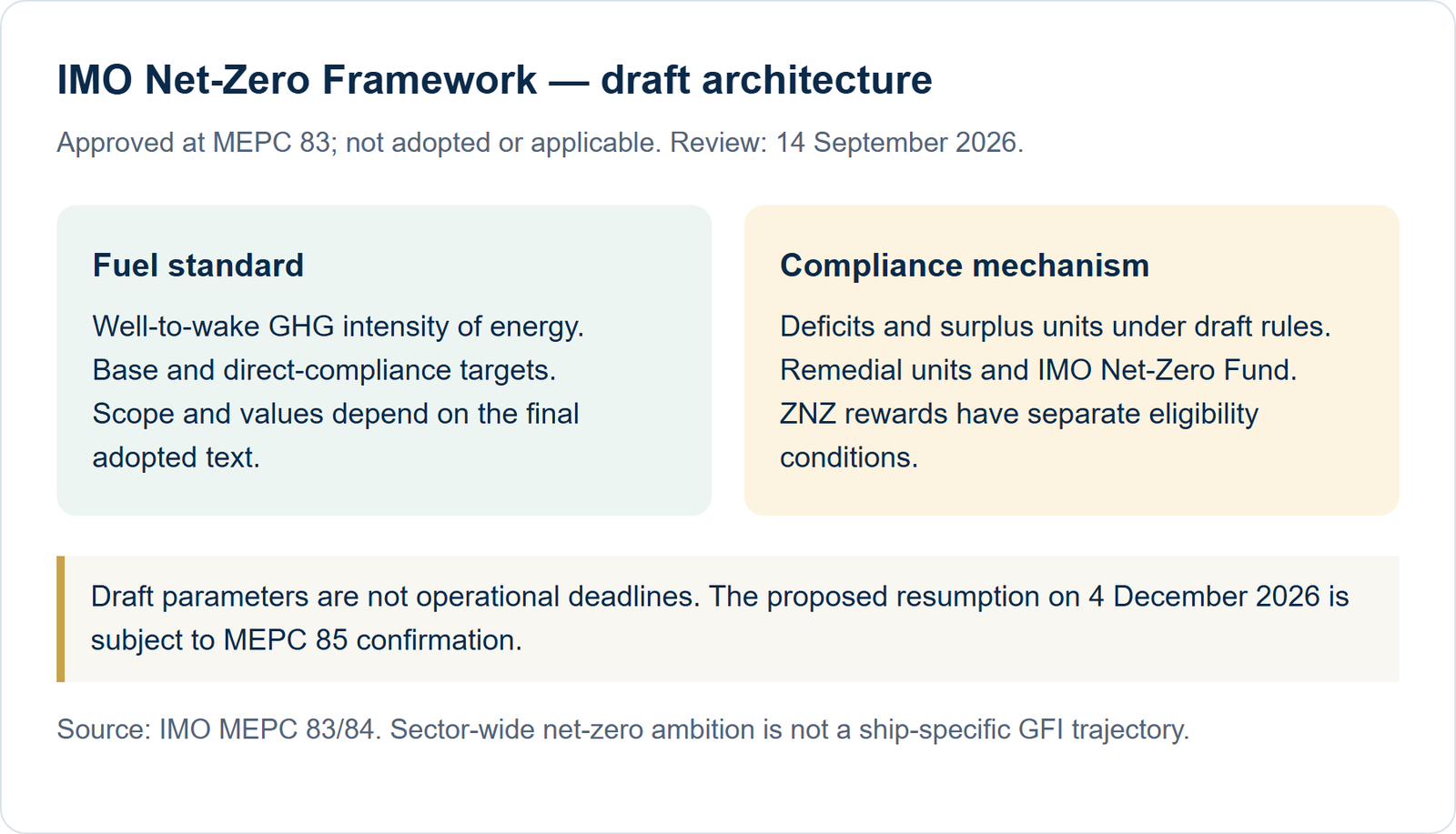
The text is approved but neither adopted nor applicable. MEPC 84 provided for further negotiations; resumption of the extraordinary session on 4 December 2026 is subject to confirmation by MEPC 85. Do not treat the proposal’s timetable as mandatory. GFI targets and unit prices remain draft parameters subject to change.
ECAs and sulphur limits
Sulphur limits: 0.50% m/m globally and 0.10% in SOx ECAs when applicable; approved equivalents under regulation 4 are permitted, subject to local discharge restrictions.
- Baltic, North Sea, North America and US Caribbean: operational SOx ECAs. NOx Tier III depends on engine and construction dates; it does not automatically apply to all ships.
- Mediterranean: ECA SOx limit from 1 May 2025.
- Canadian Arctic and Norwegian Sea: amendments in force from 1 March 2026; 0.10% SOx limit from 1 March 2027. Check the regulation 13 NOx criteria separately.
- North-East Atlantic: MEPC.407(84), entry into force 1 September 2027, SOx application 1 September 2028; NOx follows the specified construction criteria.
For the superintendent this means planning the fuel changeover and its engine-room log entries, checking tank segregation and keeping the documentary evidence on board (bunker delivery notes, samples).
End of life: the Hong Kong Convention
The Hong Kong Convention entered into force on 26 June 2025. Existing in-scope ships require an IHM by 26 June 2030 or before earlier recycling; new ships follow their own regime. Article 3 includes exclusions such as ships below 500 GT and specified State ships. Regulation (EU) 1257/2013 has its own scope: IHM requirements already applied to in-scope EU-flag ships and third-country ships calling at EU ports. Maintain the inventory according to materials actually present, supplier documentation and verification requirements.
The European front: EU ETS and FuelEU Maritime
EU ETS: for covered maritime activities, surrender covers 40% of 2024 emissions, 70% of 2025 and 100% from 2026; allowances are due by 30 September of the following year. September 2026 therefore settles 70% of 2025 emissions, not 100% of 2026. CH4 and N2O enter from 2026. Subject to derogations, coverage is 100% for intra-EEA voyages and EEA port emissions, and 50% for voyages to/from external ports. Ordinary cargo/passenger coverage starts at 5,000 GT; offshore ships from 5,000 GT enter in 2027. MRV expansion does not automatically extend ETS.
FuelEU Maritime applies from 2025 to commercial passenger/cargo ships above 5,000 GT within the regulation’s geographic scope. It limits the well-to-wake GHG intensity of energy; pooling, banking and borrowing have specific conditions and do not replace ETS surrender. Check exclusions, derogations and territorial incorporation without automatically equating the EU with the entire EEA. Penalties depend on the remaining compliance deficit under the regulation.
Reporting: EU MRV and IMO DCS
Carbon pricing and intensity standards rest on a data chain the superintendent must govern as tightly as a survey. Two regimes coexist: the IMO DCS (ships of 5,000 GT and above; annual consumption by fuel type, distance travelled and hours under way) and the EU MRV (a wider scope: ships of 5,000 GT and above and, from 1 January 2025, also general cargo ships from 400 to below 5,000 GT and offshore ships of 400 GT and above, on EU/EEA voyages, with per-voyage and per-ship emission data; the EU ETS follows its own rules and timing).
- DCS: data to the Administration/authorised organisation by 31 March; Statement of Compliance by 31 May; the Administration transfers data to IMO within one month of issue, not simply on 30 June.
- MRV: verified reports by 31 March; the authority may bring this forward, but not before 28 February. Document of compliance on board by 30 June.
- FuelEU: report to verifier by 31 January; verified report and results in the database by 31 March (Article 16.5). The 30 April deadline concerns, in particular, borrowing and pool allocation, not first recording of verified results. FuelEU document by 30 June subject to Articles 22–23.
- EU ETS: surrender by 30 September for the preceding year.
The practical risk is not the deadline but data quality: bunker delivery notes and flowmeter readings must reconcile with the engine-room records, because that figure is what allowances are paid on and what the CII rating is calculated from. An inconsistency found at verification costs more than a year of careful recording.
| Instrument | Scope | Management impact |
|---|---|---|
| EEXI | Technical, with required verification | Design verification; possible power limitation (EPL) |
| CII | Operational, annual | A–E rating; SEEMP actions; operational levers |
| IMO Net-Zero (GFI) | Global draft, ships from 5,000 GT | Fuel standard + emissions pricing (approved, not yet adopted) |
| EU ETS | EU/EEA routes | 2026 emissions at 100%, surrender in 2027; CH4 and N2O also covered from 2026 |
| FuelEU Maritime | EU regulatory scope | Onboard energy intensity limit; pooling and penalties |
Alternative fuels: an overview
| Fuel | Advantages | Drawbacks |
|---|---|---|
| LNG | Mature, reduced SOx/NOx | Unburned methane (methane slip); not net-zero |
| Methanol | Liquid, simpler handling | Low energy density; limited green availability |
| Ammonia | Zero carbon at combustion | Toxicity, safety, engines still in development |
| Biofuels | Some drop-in blends, subject to compatibility and approvals | Feedstock availability and sustainability |
| Hydrogen / fuel cells | Pure-H₂ cells: no exhaust CO₂; assess lifecycle emissions | Storage, density, immature infrastructure |
EEXI: specified ship categories from 400 GT, with exceptions and verification also after a relevant conversion; not every ship indiscriminately. CII: specified categories from 5,000 GT, not the whole DCS population. SEEMP III corrective actions following three D years/one E year must be submitted for verification within one month of reporting attained CII and no later than five months after year-end (MARPOL VI/28).
Verification sources: MEPC.392(82); MARPOL VI/13–14 ↗ · IMO, MEPC 84 ↗ · FuelEU, Reg. (EU) 2023/1805, Arts 2, 15–16, 20–23 ↗ · MRV, Reg. (EU) 2015/757, Arts 2, 11–11a, 18 ↗ · EU ETS, Dir. 2003/87/EC, Arts 3ga–3gb, 12; Annex I ↗ · Hong Kong Convention, Art. 3; Reg. 5 ↗
Key takeaways
- EEXI and CII have their own thresholds and categories; distinguish applicable rules from drafts such as the Net-Zero Framework.
- The European front, EU ETS and FuelEU Maritime, overlaps the IMO framework: they must be managed together.
- The review is dated 14 September 2026; deadlines depend on the instrument and reporting year.
Incident investigation and root cause analysis
Module objectiveConduct a structured investigation that reaches the underlying causes and closes with verified corrective action.
Every incident and every near-miss is valuable information. A structured investigation turns the event into prevention. The superintendent must conduct investigations that go beyond «operator blame» to organisational and latent causes.
The investigation process
- Securing the scene and immediate collection of evidence (facts, not opinions; objective data, testimony, recordings).
- Reconstruction of the sequence of events (timeline).
- Identification of immediate, contributing and root causes.
- Definition of corrective actions on the root cause, with owners and deadlines.
- Verification of effectiveness and sharing of lessons learned across the fleet.
Root cause analysis methods
| Method | Principle | Typical use |
|---|---|---|
| 5 Whys | Asking «why» repeatedly down to the root | Simple events, quick analysis |
| Ishikawa (fishbone) | Causes grouped by category (man, machine, method...) | Structured brainstorming |
| TRIPOD Beta / barrier model | Latent causes and failed barriers | Complex events, organisational factors |
| Fault/Event Tree | Combinatorial logic of failures/events | Complex technical systems |
Stopping at «the operator made a mistake» is the surest way to let the accident happen again. Human error is almost always the symptom of latent conditions: ambiguous procedures, fatigue, insufficient training, time pressure, design that invites error. The right question is not «who made the mistake» but «why did the error become likely for a competent person».
The company SMS investigation is separate from the State safety investigation under the Casualty Investigation Code (MSC.255(84), Parts I–II mandatory through SOLAS XI-1/6). Preserve originals and traceability of copies; coordinate with the competent investigators. Five Whys and diagrams suggest hypotheses: causal findings need evidence, without forcing a single root cause.
Verification sources: ISM Code, §§1.1.10, 3–5, 9–10, 12–14 ↗
Key takeaways
- An investigation starts from facts and objective evidence, not from opinions.
- 5 Whys, Ishikawa and the other methods are chosen according to the complexity of the event.
- Corrective action without verification of effectiveness and fleet-wide dissemination does not close the cycle.
Digitalisation and emerging risks
Module objectiveAssess the use of condition monitoring, fleet analytics and remote surveys, and place cyber risk inside the SMS.
Technical management is changing shape: data, connectivity and new threats are redefining the superintendent's job. Those who master these tools gain more control and foresight; those who ignore them fall behind.
From data to decision
- Condition monitoring and IoT: sensors on critical machinery feed condition-based and predictive maintenance, reducing failures and downtime.
- Fleet performance & noon-data analytics: consumption, speed and weather data processed to optimise routes and reduce carbon intensity (with a direct impact on CII).
- Remote & digital surveys: some class verifications are carried out remotely, reducing waiting times and costs, within the limits allowed by the RO.
Cyber security on board
A connected ship is also a ship that can be attacked. IMO Resolution MSC.428(98) encourages Administrations to ensure that cyber risks are appropriately addressed in the Safety Management System (SMS); that expectation is verified within the ISM implementation of the company and its Administration, from the first annual DOC verification after 1 January 2021. The superintendent oversees the inventory of OT/IT systems, network segregation, access management, updates and crew training.
For newbuildings, IACS UR E26 and E27 also apply to ships contracted for construction on or after 1 July 2024: the first covers the cyber resilience of the ship as a whole, the second that of individual onboard systems and equipment. Anyone supervising a newbuilding finds them in the specification — not as good practice but as a class requirement.
Sensors and dashboards provide more information, not more wisdom. The superintendent's value remains in interpreting data in the context of the individual ship and in deciding. The new risk is over-reliance on a dashboard that «looks fine» while the reality on board says otherwise: physical visits and dialogue with the crew remain irreplaceable.
Sensors enable monitoring but do not guarantee fewer failures: reliable data, thresholds and operational response are needed. For E26/E27 check ship type, UR revision and class rules; contract date alone is insufficient. Updated IMO guidance is MSC-FAL.1/Circ.3/Rev.3 (2025).
Verification sources: MSC-FAL.1/Circ.3/Rev.3; MSC.428(98) ↗
Key takeaways
- Condition data support maintenance only when reliable and followed by appropriate action.
- Analytics help select actions; CII changes through actual consumption and activity.
- MSC.428(98) encourages Administrations to ensure cyber risk is addressed in the SMS: it is verified within the ISM framework.
Insurance, claims and emergency response
Module objectiveKnow which cover responds to which event, which notifications to make in the first hour and how evidence is preserved.
The superintendent does not place the policies, but is the person who — when something goes wrong — either builds or destroys the evidence. Knowing who covers what, which notifications to make and how evidence is preserved is what separates a paid claim from a loss the company carries itself.
Who covers what
| Cover | What it answers for | Note for the Superintendent |
|---|---|---|
| H&M — Hull & Machinery | Damage to the ship's hull and machinery | Check deductible and survey arrangements; do not delay urgent safety work |
| P&I — Protection & Indemnity | Third-party liabilities: pollution, crew, cargo, wreck removal | Mutual or fixed-premium cover: notify and coordinate any survey |
| Loss of Hire (optional) | Loss of hire beyond a deductible expressed in days | The day count is defended with logs and certificates, not from memory |
| War risks | War risks and listed areas | Prior notification for high-risk areas; additional premiums |
| Cargo insurance | The cargo itself, for shipper or receiver | Does not cover the ship: watch for security demands in case of average |
Off-hire and general average
Under a time charter the ship goes off-hire when an event listed in the clause prevents her from providing the agreed service. The argument is almost never about the principle but about the hours: start, end and cause must be documented with the log book, notification e-mails and technical evidence.
General average requires an extraordinary sacrifice or expenditure intentionally and reasonably made for common safety from peril. York-Antwerp Rules operate through contractual incorporation and applicable law: declaration, contribution and security do not automatically follow every casualty. Coordinate with the owner, average adjuster and advisers; distinguish a bond from an insurer’s guarantee and record expenditure separately.
The first hour after the event
- Safety of people and of the ship; everything else comes after.
- Notifications: owner, DPA, flag, class, P&I and — where there is pollution or a risk of it — the coastal authority under the SOPEP/SMPEP.
- Preservation of evidence: the VDR keeps the most recent hours in the capsule and a longer period in onboard memory, but it overwrites. The instruction to save the data must be given at once, in writing, and the copy kept dated and signed.
- Verified facts kept distinct from preliminary hypotheses: no speculation on causes, no unauthorised admission of liability, and no document reconstructed after the fact.
- A single chronological record of events and communications, opened in the first minute.
Salvage, ERS and emergency plans
In case of grounding, flooding or fire, a ship enrolled in an Emergency Response Service can receive round-the-clock support: residual stability and strength calculations on the lodged model, within hours. It is not automatic: it normally requires a contract, prior enrolment, and an up-to-date model and data. It must be checked in advance, not discovered on the day.
Salvage and assistance terms may be governed by the Lloyd's Open Form (no cure, no pay) or by other agreements; whether SCOPIC — a specific contractual regime of special compensation — applies must be checked against the contract and the clause in force, with P&I and advisers. The difference between commercial towage and salvage is not a matter of wording: it changes who pays, and how much.
United States trading: OPA-90
Depending on ship type, tonnage and activity, an approved Vessel Response Plan, a Qualified Individual reachable around the clock, contracts with qualified OSROs and the Certificate of Financial Responsibility may be required — the last generally for ships above 300 GT, with exceptions, and for ships of any tonnage engaged in lightering or transshipment of oil in the EEZ. Applicability must be checked case by case against 33 CFR and USCG guidance: where they apply they are conditions of entry, and no insurance cover makes up for them.
Open a single file from the first minute: chronology, dated photographs, log extracts, correspondence, surveyors' reports. Separate verified facts, preliminary hypotheses and conclusions; do not speculate or admit liability; coordinate reports and communications with the SMS, the authorities, P&I and advisers, preserving the evidence. The SMS, the flag State, the authorities and insurers may require preliminary reports and causal analysis: the risk to avoid is not writing, it is speculating or altering the facts. An orderly file shortens settlement and, in a dispute, is worth more than any later reconstruction.
Cover depends on the policy, exclusions, deductibles and conditions: contractual off-hire does not equal an insured Loss of Hire claim. P&I may be mutual or fixed-premium. Also notify the H&M insurer/broker where relevant; do not delay urgent safety measures while awaiting a surveyor. Save VDR and other data immediately using the installed system, preserving originals and recording who, when, copying and custody.
Verification sources: CMI, York-Antwerp Rules, Rule A ↗
Key takeaways
- H&M covers hull and machinery, P&I covers liability to third parties: they are distinct covers.
- In the first hour what counts is prompt notification and preservation of evidence, not later reconstruction from memory.
- The Loss of Hire day count is defended with logs and certificates.
Recurring mistakes
From the Mistake Library of SuperbaKnowledge, filtered to the subjects this course covers. This view selects and organises content published in SuperbaKnowledge; it does not modify or replace it. The linked Knowledge page remains the reference version, while official texts remain authoritative.
| Topic | Mistake | Typical consequence | Topic sheet |
|---|---|---|---|
| Annual Survey | Annual Survey treated as a minor formality, prepared with less rigor than the Renewal | Early indications of problems are not detected or addressed promptly | See the topic sheet |
| Flag Change | Flag change completed without ensuring continuity of statutory certificate validity | Documentary gap period in which the ship operates without fully valid certificates | See the topic sheet |
| Condition of Class and Recommendations | Condition of Class treated as lower priority than a PSC deficiency or an ISM Non-Conformity | Deadline missed, risk of class suspension | See the topic sheet |
| HSSC-Vetting Coordination | HSSC calendar and vetting inspection calendar managed separately without being shared | Unintended concentration of surveys and vetting inspections in the same time window | See the topic sheet |
| Corrective and Preventive Action (CAPA) | Corrective action addressing the symptom, not the root cause | The NC recurs in similar form | See the topic sheet |
| Cyber Risk Management in the SMS (MSC.428(98)) | Cyber risk managed as a separate IT matter, not integrated into the SMS's general risk assessment | Lack of integrated documentary evidence in the event of an audit, despite the existence of technical IT measures | See the topic sheet |
| Designated Person Ashore (DPA) | DPA appointed only formally, without real access to top management | NC in certification audit, ineffective escalation system in an emergency | See the topic sheet |
| Document of Compliance (DOC) and Safety Management Certificate (SMC) | DOC and SMC periodical verifications treated as if they had the same cadence, applying the SMC's intermediate window to the DOC | The Code does not say the certificate lapses by itself: §13.5 provides for withdrawal of the DOC when the annual verification is not requested, §13.9 for withdrawal of the SMC when the intermediate one is not. Both omissions are detainable deficiencies (A.1206(34), App. 2, §5 “Areas under the ISM Code”): item .8 “Evidence of the DOC annual verification is not available on board” and item .4 “The SMC intermediate verification is overdue” | See the topic sheet |
| HSSC | Intermediate Survey planned as if it had the same window as the Annual Survey, i.e. ±3 months around every anniversary date | Survey placed outside its window: the Intermediate window is ±3 months around the second or the third anniversary date (SOLAS I/10(a)(iii)) | See the topic sheet |
| Harmonized System of Survey and Certification (HSSC) | Intermediate Survey window not tracked with the same priority as Renewal | The certificate shall cease to be valid by force of SOLAS regulation I/14(i)(i), and it does so also where the survey was carried out but not endorsed on the certificate (subparagraph (ii)) | See the topic sheet |
| ISPS Certification | ISSC intermediate audit scheduled right up against the deadline of the window between the 2nd and 3rd anniversary | Risk of missing the required window | See the topic sheet |
| International Load Line Certificate | Operating draft exceeding the assigned freeboard for the zone/season | Direct violation of the Convention, reduction of the real safety margin | See the topic sheet |
Related PSC deficiencies
From the PSC Knowledge Base of SuperbaKnowledge. This view selects and organises content published in SuperbaKnowledge; it does not modify or replace it. The linked Knowledge page remains the reference version, while official texts remain authoritative.
| Deficiency | Regulation | Indicative frequency | Possible consequence | Topic sheet |
|---|---|---|---|---|
| Certificate extended beyond the 3 months permitted from the original expiry | HSSC — Res. A.1207(34) | Low-Medium | Certificate considered invalid, possible detention | See the topic sheet |
| Internal audit beyond 12 months without documented exceptional circumstances, or beyond the exceptional 15-month limit | ISM Code, para. 12 | Medium-High | NC at external DOC/SMC renewal audit | See the topic sheet |
Glossary of acronyms
| Acronym | Definition |
|---|---|
| AFS | Anti-Fouling Systems Convention (2001) |
| ASR | State-Regions Agreement (training) |
| BWM | Ballast Water Management Convention |
| BWMC | Ballast Water Management Certificate |
| CAPA | Corrective and Preventive Action |
| CBM | Condition-Based Maintenance |
| CDI | Chemical Distribution Institute (chemical tanker vetting) |
| CII | Carbon Intensity Indicator |
| CMS | Continuous Machinery Survey |
| CoC | Condition of Class |
| CSO | Company Security Officer |
| CVIQ | Compiled Vessel Inspection Questionnaire (SIRE 2.0) |
| DCS | IMO Data Collection System (fuel oil consumption) |
| DOC | Document of Compliance (ISM) |
| DPA | Designated Person Ashore |
| ECA | Emission Control Area |
| EEXI | Energy Efficiency Existing Ship Index |
| EPL | Engine Power Limitation |
| ESP | Enhanced Survey Programme |
| ETS | Emissions Trading System (EU) |
| GFI | GHG Fuel Intensity |
| GT | Gross Tonnage |
| H&M | Hull & Machinery insurance |
| HSSC | Harmonized System of Survey and Certification |
| IACS | International Association of Classification Societies |
| IAPP | International Air Pollution Prevention Certificate |
| IHM | Inventory of Hazardous Materials |
| ILLC | International Load Line Certificate |
| IOPP | International Oil Pollution Prevention Certificate |
| ISM | International Safety Management Code |
| ISPS | International Ship and Port Facility Security Code |
| ISSC | International Ship Security Certificate |
| LTIF | Lost Time Injury Frequency (lost-time injuries per 106 hours worked) |
| MEPC | Marine Environment Protection Committee (IMO) |
| MLC | Maritime Labour Convention 2006 |
| MoC | Management of Change |
| MoU | Memorandum of Understanding (PSC) |
| MRV | Monitoring, Reporting and Verification (EU emissions regime) |
| MTBF | Mean Time Between Failures |
| OCIMF | Oil Companies International Marine Forum |
| OPEX | Operating Expenditure |
| P&I | Protection & Indemnity (liability insurance) |
| PMS | Planned Maintenance System |
| PSC | Port State Control |
| RO | Recognized Organization |
| SEEMP | Ship Energy Efficiency Management Plan |
| SIRE | Ship Inspection Report Programme |
| SMC | Safety Management Certificate |
| SMS | Safety Management System |
| SOLAS | Safety of Life at Sea |
| SSO | Ship Security Officer |
| SSP | Ship Security Plan |
| STCW | Standards of Training, Certification and Watchkeeping |
| TMSA | Tanker Management and Self Assessment |
| VIQ | Vessel Inspection Questionnaire (SIRE, until 2024) |
| ZNZ | Zero or Near-Zero GHG emission fuels |
Regulatory references and sources
Consolidated list of the sources cited in the course, grouped by nature. The references carry a reference date of 14 September 2026: always consult the latest official version in force before any operational application.
Guidelines are not automatically standalone obligations: read the convention, implementation and applicable rules. Additional references checked in this review: HSSC A.1207(34); PSCC59/2026/03; IACS III 5/INF.27; MEPC.392(82); York-Antwerp Rules; Casualty Investigation Code MSC.255(84); MSC-FAL.1/Circ.3/Rev.3.
Conventions, instruments and IMO/EU guidelines
| Source | Organisation | Reference and date | Modules |
|---|---|---|---|
| SOLAS 1974, as amended | IMO | Ch. IX (ISM), Ch. XI-2 (ISPS) | 2, 3, 5 |
| MARPOL 73/78, Annexes I–VI | IMO | Annex VI for efficiency and emissions | 2, 10 |
| ISM Code — International Safety Management Code | IMO | SOLAS Ch. IX | 2, 3, 4, 12 |
| ISPS Code — International Ship and Port Facility Security Code | IMO | SOLAS Ch. XI-2 | 2 |
| MLC 2006 — Maritime Labour Convention | ILO | in force since 2013 | 2 |
| STCW 1978 | IMO | Manila amendments 2010 | 2 |
| Resolution MEPC.328(76) | IMO | revised MARPOL Annex VI: EEXI and CII | 10 |
| Resolutions MEPC.352(78) (as amended by MEPC.412(84)), MEPC.353(78), MEPC.338(76) (as amended by MEPC.400(83)), MEPC.354(78), MEPC.355(78) | IMO | CII Guidelines G1–G5, respectively: indicators and calculation methods, reference lines, reduction factors, rating, correction factors and voyage adjustments | 10 |
| Resolution MEPC.395(82), as amended by MEPC.401(83) and MEPC.413(84) | IMO | 2024 Guidelines for the development of the SEEMP, including Part III; revokes MEPC.346(78) (2022), previously amended by MEPC.388(81) | 10 |
| Resolution MSC.428(98) | IMO | cyber risk management within the SMS | 12 |
| ESP Code — Resolution A.1049(27) and subsequent amendments | IMO | Enhanced Survey Programme, bulk carriers and tankers | 5 |
| Hong Kong Convention 2009 | IMO | in force since 26 June 2025; IHM | 10 |
| Regulation (EU) 2023/1805 — FuelEU Maritime | European Union | GHG intensity of energy used on board | 10 |
| Directive (EU) 2023/959 — EU ETS | European Union | extension to maritime transport | 10 |
| Regulation (EU) 2015/757, amended by Reg. (EU) 2023/957 | European Union | MRV: monitoring, reporting and verification | 10 |
Industry guidance
| Source | Organisation | Reference and date | Modules |
|---|---|---|---|
| SIRE 2.0 — Ship Inspection Report Programme | OCIMF | replaced VIQ7 on 2 September 2024 | 8 |
| TMSA — Tanker Management and Self Assessment | OCIMF | company self-assessment | 8 |
Inspection and classification references
| Source | Organisation | Reference and date | Modules |
|---|---|---|---|
| Paris MoU, Tokyo MoU and the USCG regime | Regional MoUs and US Coast Guard | Port State Control regimes | 7 |
| Paris MoU — 46th amendment and instructions | Paris MoU | 2025 text; PSCC59/2026/03 (2026) for action codes | 7 |
| Class rules | IACS and classification societies | construction, maintenance and survey cycle | 2, 5, 6 |
| IACS UR E26 and E27 | IACS | ships contracted from 1 July 2024; cyber resilience | 12 |
Sources to monitor for updates
| Source | Organisation | Reference and date | Modules |
|---|---|---|---|
| IMO Net-Zero Framework | IMO | approved at MEPC 83 (2025), not yet adopted | 10 |
| Outcome of MEPC 84 | IMO | 27 April – 1 May 2026; Net-Zero Framework, North-East Atlantic ECA, CII review | 10 |
IMO — imo.org (conventions, MEPC/MSC resolutions, Net-Zero Framework status).
OCIMF — ocimf.org (SIRE 2.0 and TMSA documentation).
Paris MoU / Tokyo MoU (inspection regimes, performance lists).
Flag Administration and classification society (RINA/IACS) for applicable requirements.
This course is educational material for training purposes and does not constitute a professional certification or qualifying credential. Read the full disclaimer.