Learning objectives
- Explain the environmental problem of invasive species transported via ballast water.
- Distinguish between the Convention's D-1 and D-2 standards.
- Understand the general operation of a Ballast Water Management System (BWMS).
- Manage the required documentation (BWMP, Record Book, Certificate).
- Recognise the typical areas checked in a PSC inspection on ballast water.
The environmental problem of invasive species
Module objectiveUnderstand how ballast water and sediments transfer organisms between ecosystems and distinguish transfer prevention, D-1 exchange and D-2 performance.
Ships that take on ballast water for stability in one port and discharge it in another carry, along with the water, aquatic organisms, larvae and sediments that can survive the voyage and establish themselves in an entirely foreign ecosystem, with sometimes serious ecological and economic consequences.
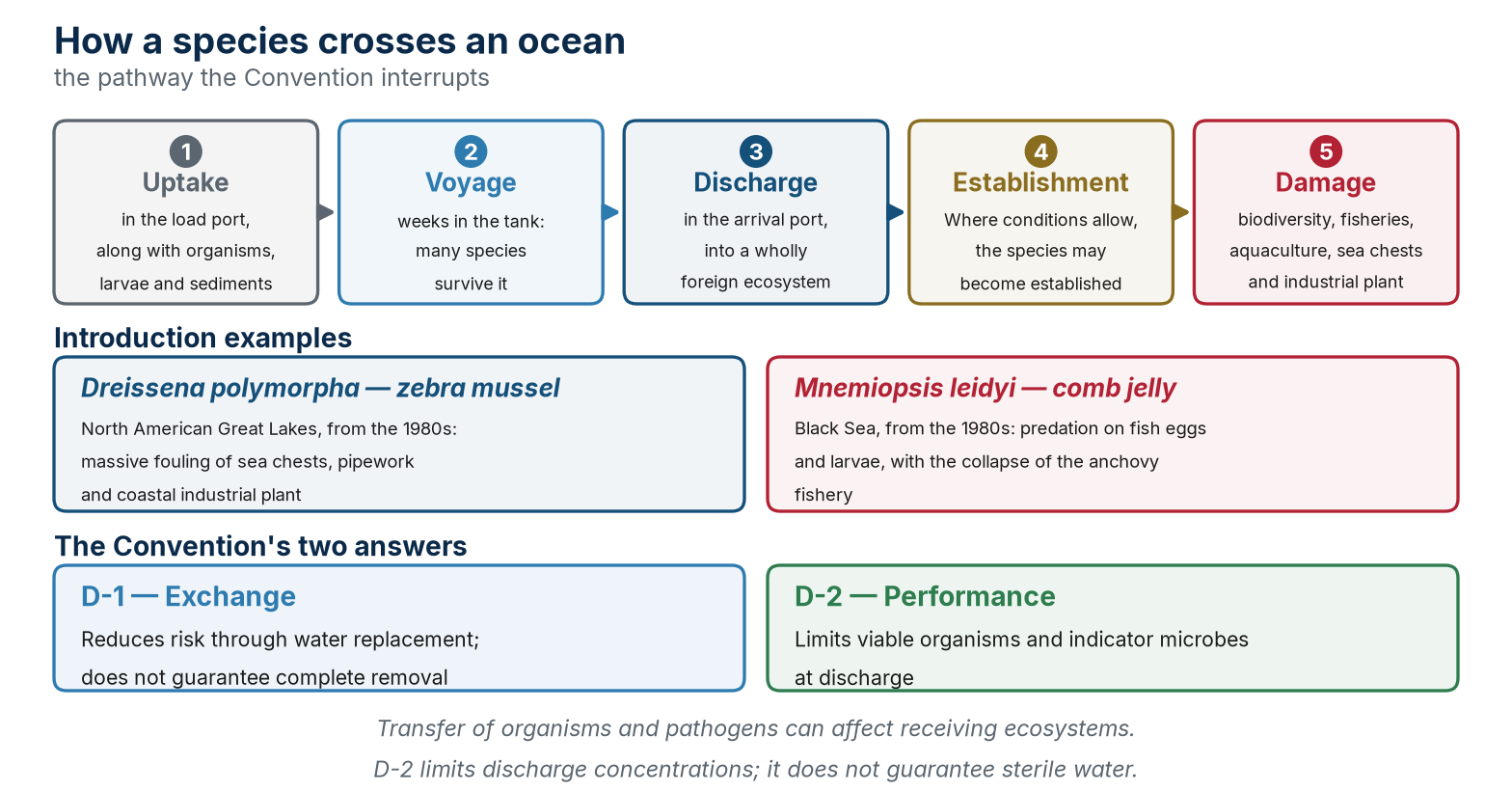
The problem of invasive species transported by ballast water has been recognised as one of the main threats to global marine biodiversity, on a par with chemical pollution, which is why the international community developed a convention specifically dedicated to this risk.
Hull and niche-area biofouling is a separate vector. Ballast management reduces organism and pathogen transfer; it neither guarantees sterile water nor replaces biofouling management. Risk depends on organisms, quantity, survival and receiving-site conditions.
Key takeaways
- Risk arises from uptake, transport and discharge, and from organisms surviving and establishing in a new environment.
- Ballast water and sediments are both vectors; biofouling is a separate vector addressed by different instruments.
- D-1 reduces risk through exchange; D-2 places quantitative limits on viable organisms and indicator microbes at discharge.
The Ballast Water Management Convention
Module objectiveDetermine whether the Convention, survey/certification regime and principal B-1–B-6 and E-1 requirements apply to an individual ship.
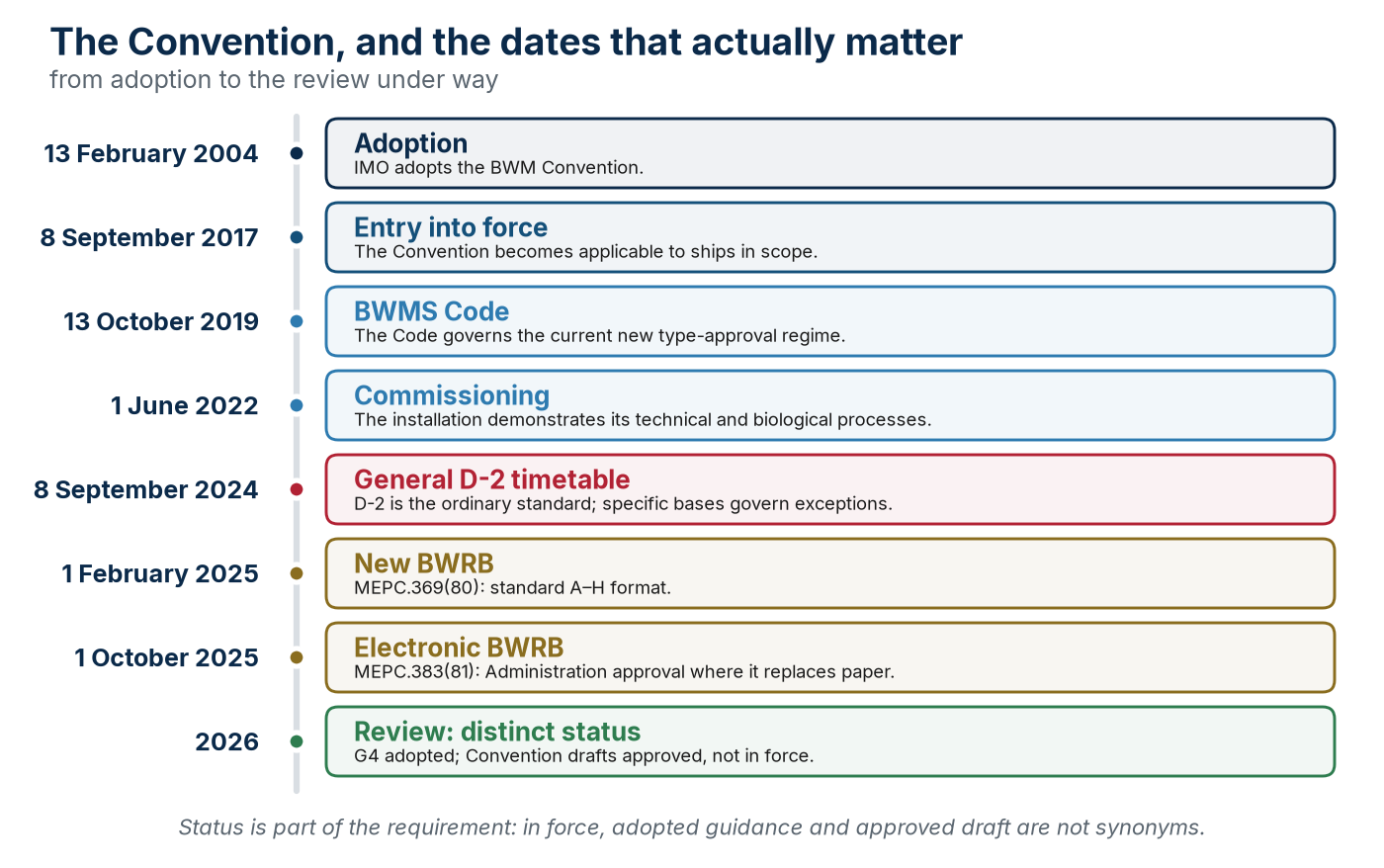
The BWM Convention was adopted on 13 February 2004 and entered into force on 8 September 2017. It is an IMO instrument distinct from MARPOL.
Application and certification
The Convention applies to ships entitled to fly the flag of a Party and ships operating under the authority of a Party, subject to Article 3 exclusions and determinations. Warships, naval auxiliaries and State ships used only on government non-commercial service are excluded; limited trades require verification of the competent Party’s decision.
Section E survey and certification generally applies to ships of 400 GT and above, excluding floating platforms, FSUs and FPSOs. For other ships subject to the Convention, the Party establishes appropriate measures. Flag, operating area, service, tonnage, exclusions, exemptions and implementing law must be checked.
Main obligations
- B-1: approved ship-specific BWMP.
- B-2: traceable BWRB retained for the required periods.
- B-3/B-4: applicable standard and exchange conditions.
- B-5/B-6: sediments, duties and familiarisation.
- E-1: survey and certification where applicable.
The 400 GT threshold is not a general exemption from substantive duties. Article 3 also excludes, on its terms, ships not designed to carry ballast and permanent ballast in sealed tanks that is not discharged. Retain the documentary basis for a ship’s exclusion or exemption; do not infer it solely from tonnage or a domestic voyage.
Key takeaways
- Application, exclusions and determinations depend on Article 3, flag and operating area.
- BWMP, BWRB, applicable standard, sediment management and familiarisation form one compliance system.
- The 400 GT threshold concerns the international survey and certification regime; it does not by itself create a substantive exemption.
The D-1 and D-2 standards
Module objectiveApply D-1/B-4 criteria and interpret all five D-2 limits without confusing the general timetable with exceptions and contingency measures.
D-1 defines volumetric exchange; D-2 sets biological discharge performance. The general D-2 timetable was completed in 2024, subject to specific grounds for exclusions, exemptions and other permitted arrangements.
D-1: what «exchange» actually means
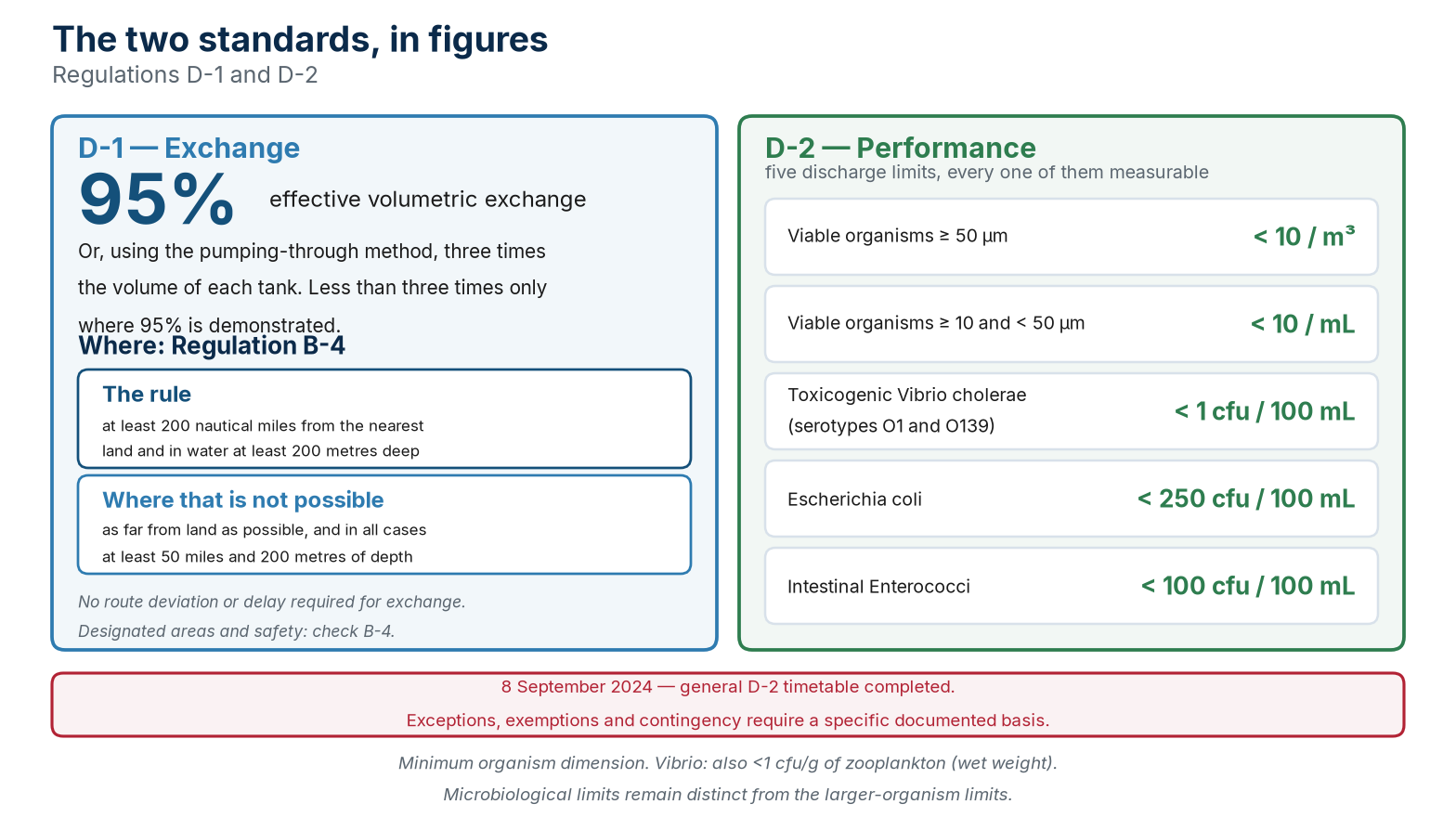
The D-1 standard is met with an effective volumetric exchange of at least 95%. Using the pumping-through method the criterion is taken as met by pumping three times the volume of each tank; less than three times is acceptable only where 95% is demonstrated.
Regulation B-4 sets out where: at least 200 nautical miles from the nearest land and in water at least 200 metres deep. Where that is not possible, as far from the nearest land as possible and in all cases at least 50 nautical miles away and in water at least 200 metres deep. Where neither is achievable, the port State may designate exchange areas in consultation with neighbouring States. And there is a clause worth knowing: the ship is not required to deviate from its route or delay the voyage in order to exchange.
| Standard | Method | Characteristics |
|---|---|---|
| D-1 | Ballast water exchange at sea, under the conditions of Regulation B-4 | Dilutes the concentration of coastal organisms by replacing them with oceanic ones, which rarely survive in coastal waters; does not guarantee complete removal or D-2 compliance |
| D-2 | Performance standard, normally achieved with an approved BWMS | Reduces viable organisms below five numerical limits — two by size and three microbiological — verifiable by analysis; the definitive standard |
D-2 in figures
This is the heart of the subject, and what the course must be able to state without hesitating: D-2 is not «clean water», it is a set of five measurable limits.
| Category | Discharge limit |
|---|---|
| Viable organisms ≥ 50 µm in minimum dimension | fewer than 10 per cubic metre |
| Viable organisms in minimum dimension ≥ 10 µm and < 50 µm | fewer than 10 per millilitre |
| Toxicogenic Vibrio cholerae (serotypes O1 and O139) | fewer than 1 cfu per 100 mL, or per gram of zooplankton sample (wet weight) |
| Escherichia coli | fewer than 250 cfu per 100 mL |
| Intestinal Enterococci | fewer than 100 cfu per 100 mL |
Indicator microbes also address public-health risk: meeting the larger-organism limits does not automatically demonstrate microbiological compliance.
The transition timetable is Regulation B-3 as amended by resolution MEPC.297(72), in force since 13 October 2019, which anchored each ship's compliance date to its IOPP renewal survey. The final deadline was 8 September 2024: from that date D-2 is the ordinary standard for ships in scope that have reached their compliance date. Exceptions, exemptions, reception facilities, other permitted methods and contingency require a specific basis, the approved plan and, where applicable, competent-authority acceptance.
D-2 is a discharge performance standard, normally achieved through an approved BWMS, not a technology name. Size classes refer to an organism’s minimum dimension and numerical limits are strictly less than, not “less than or equal to”. Exchange can remove organisms with the water but guarantees neither elimination nor D-2 compliance. If exchange compromises safety, stability or strength, the master applies B-4.4 and records the reasons under B-4.5; this does not automatically authorise discharge at the next port.
Key takeaways
- D-1 requires at least 95% volumetric exchange and B-4 geographical conditions unless a designated area applies.
- D-2 sets two organism-size limits and three microbiological limits at discharge.
- Since 8 September 2024, D-2 is the ordinary standard for ships generally within scope; residual uses of D-1 need a specific documented basis.
How a BWMS works
Module objectiveConnect technology, type approval, system design limitations, monitoring and maintenance to D-2 performance of the individual installation.
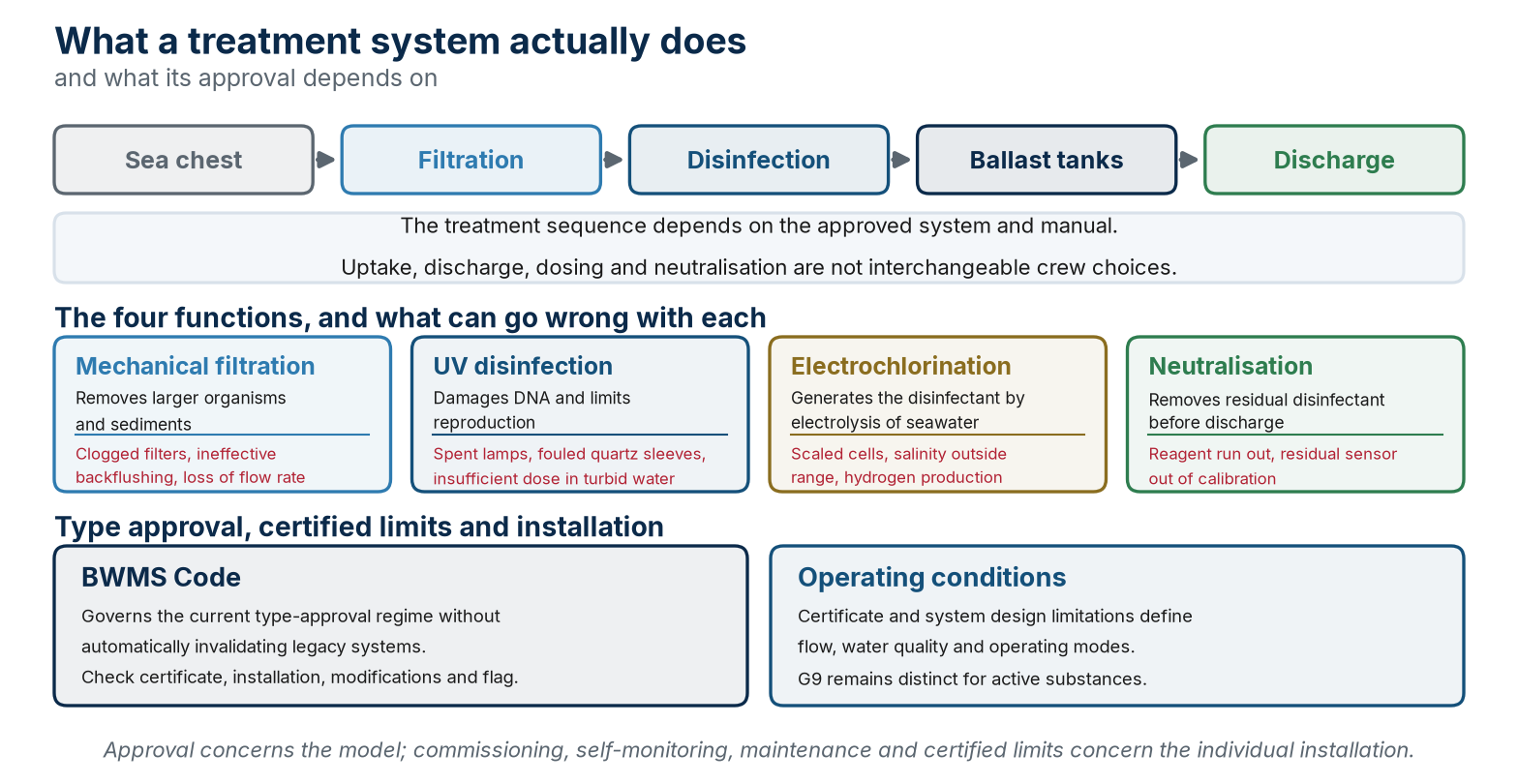
Ballast Water Management Systems (BWMS) use combinations of physical and chemical technologies to reduce the concentration of viable organisms below the thresholds required by the D-2 standard.
Type approval no longer follows G8
The BWMS Code, MEPC.300(72), was made mandatory by MEPC.296(72), in force from 13 October 2019. Distinguish this date from the 28 October 2020 installation criterion. Check the certificate, conditions and approval limitations of the actual configuration.
A system using an Active Substance — electrochlorination, chlorination, ozone — additionally requires approval under Procedure G9, which assesses the risk to the environment, to human health and to the ship, and sets the limits for residuals at discharge.
| Technology | Operating principle |
|---|---|
| Mechanical filtration | Physically removes larger organisms and sediments |
| UV disinfection | Damages organisms' DNA using ultraviolet light, preventing reproduction |
| Electrochlorination | Generates a disinfecting agent through electrolysis of the seawater itself |
| Neutralisation | Some systems require neutralisation of the residual disinfectant before discharge |
A BWMS that is installed but poorly maintained (spent UV lamps, clogged filters, uncalibrated sensors) may fail to achieve the required performance, exposing the ship to a risk of non-compliance despite formally having met the installation obligation.
Before each operation check certified limits: flow, salinity, temperature, UV transmittance where relevant, dose and minimum holding time. Filtration, uptake/discharge treatment and neutralisation follow the approved manual; these are not interchangeable stages. Calibrate sensors and retain alarms and records. The BWMS Code applies to systems installed from 28 October 2020 under the applicable definition; earlier systems require verification of their approval and acceptance conditions, not an automatic declaration of invalidity.
Key takeaways
- Filtration, UV, active substances and neutralisation have different failure modes and operating limits.
- IMO type approval, G9 approval for active substances and USCG acceptance are separate processes.
- A certificate and installed system do not alone demonstrate performance; certified conditions, sensors, consumables and maintenance matter.
When the system cannot treat
Module objectiveDistinguish commissioning, technical malfunction, challenging water quality, A-3 exceptions and contingency measures agreed with the port State.
An approved BWMS must be verified on its individual installation and managed under the approved plan. Technical failure, challenging water quality, A-3 exceptions and contingency are different categories.
Commissioning test
The regulation E-1 commissioning test at initial survey and at an additional survey undertaken to install a BWMS demonstrates that mechanical, physical, chemical and biological processes work correctly. BWM.2/Circ.70/Rev.1 calls for a representative discharge sample, analysis of at least the two D-2 size classes, assessment of self-monitoring and collection/analysis independent of the maker or supplier to the Administration’s satisfaction. It is not a full repetition of type approval.
A failed result creates a technical non-conformity to diagnose and rectify before certification. Cost and responsibility among owner, yard, installer, maker and testing provider depend on cause, contract and evidence.
Regulation A-3: defined exceptions
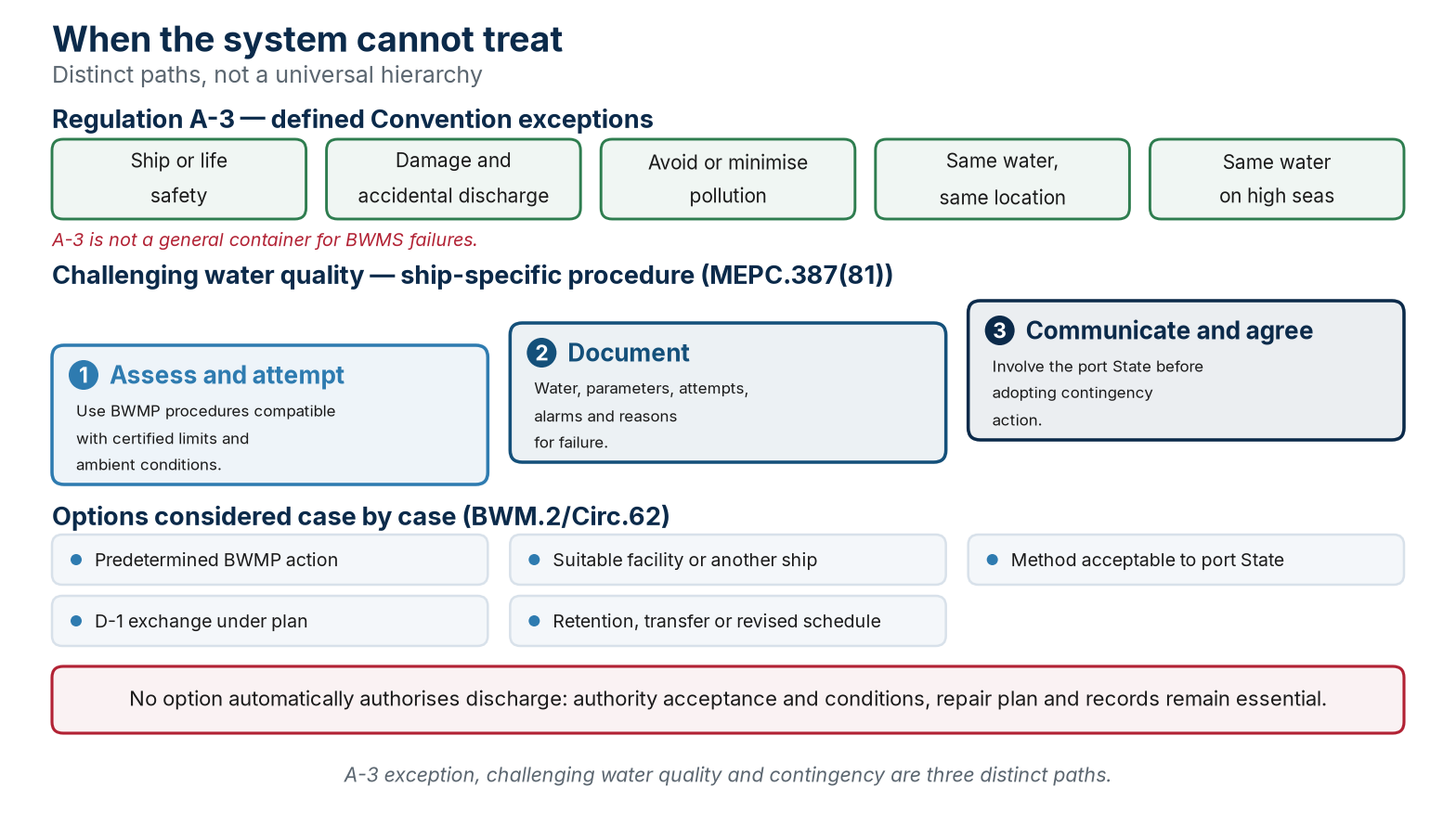
A-3 identifies limited cases: ship safety or saving life; accidental discharge or ingress resulting from damage subject to its conditions; avoiding or minimising a pollution incident; uptake and discharge on the high seas of the same water; and uptake and discharge at the same location without relevant mixing. It is not a general container for BWMS failures.
Contingency: case-by-case with the port State
For non-compliant water, ship and port State communicate and consider BWM.2/Circ.62 options: BWMP actions; discharge to another ship or suitable facility; a method acceptable to the port State; D-1 exchange under the approved plan; revised schedule, internal transfer or retention on board. Discharge remains subject to authority acceptance and conditions. Failure, repair plan, consultation and decisions must be recorded.
Challenging water quality
The reference is MEPC.387(81). It addresses ambient characteristics such as high suspended solids or turbidity that prevent the BWMS from meeting operational demand; it does not automatically cover temperature or salinity outside system design limitations or replace technical-failure contingency. Procedures must be ship-specific and included in the BWMP.
Mandatory commissioning from 1 June 2022 concerns installation verification under E-1: an additional survey confirms the test when undertaken to install a BWMS. Not every significant repair automatically requires new biological commissioning; establish the required verification with the Administration. Commissioning analysis is indicative under MEPC.325(75), using BWM.2/Circ.70/Rev.1 criteria. In CWQ, treat as much as practicable and regard bypass only as a last resort under the plan. Following bypass, plan tank and line decontamination and compliance of subsequent discharge: exchange plus treatment alone may be insufficient. Record volumes, tanks, conditions, attempts, communications and decisions.
Key takeaways
- Commissioning validates the individual installation through technical processes, self-monitoring and biological testing; it does not repeat type approval.
- MEPC.387(81) addresses challenging water quality; BWM.2/Circ.62 guides contingencies for non-compliant water.
- No contingency automatically authorises discharge: communication, agreed measure, authority conditions, repair plan and records are essential.
Required documentation
Module objectiveVerify consistency, validity, approval and traceability of the BWMP, BWRB, certificate and electronic records.
Documentation management is central to demonstrating compliance with the Convention, both in routine inspections and in targeted PSC checks.
| Document | Function |
|---|---|
| Ballast Water Management Plan (BWMP) | Describes the ship's specific operating procedures for ballast water management |
| Ballast Water Record Book | Log of every ballasting, treatment and discharge operation |
| International BWM Certificate | Records statutory verification of the ship and its stated management method |
The Record Book changed form on 1 February 2025
Resolution MEPC.369(80) replaced the model Ballast Water Record Book. From 1 February 2025 entries follow a standardised format with operation codes from letter A to H and item numbers, on the model of the Oil Record Book; the guidance for completing it is BWM.2/Circ.80/Rev.1, which also contains examples for the unusual cases. The requirement applies to existing ships as well, not only to new buildings.
Retention is set by Regulation B-2: two years on board from the last entry, then three years under the company's control. Each operation is recorded without delay and signed by the officer in charge; each completed page is signed by the master.
From 1 October 2025, amendments MEPC.383(81) recognise an electronic BWRB. Where it replaces the paper book, the system must be approved by the Administration taking account of MEPC.372(80) and preserve authentication, amendment traceability, master verification and availability for inspection. The 2026 G4 is adopted guidance under MEPC.409(84); Convention drafts approved at MEPC 84 are not yet in force.
As with hours of rest in the MLC 2006 course, the Ballast Water Record Book must also be completed with genuine accuracy, not «for convenience»: discrepancies between the records and the operations actually carried out are among the most frequent deficiencies found by PSC inspectors in this area.
The international BWM certificate records statutory verification; the type approval certificate concerns the BWMS model. They are not interchangeable and alone do not guarantee every discharge is compliant. Keep the approved BWMP, certified method, actual installation and limitations consistent. Entries must distinguish uptake, management, discharge, reception-facility transfer, exceptional operations, failures and cleaning; also retain alarm and maintenance evidence. An electronic record book needs the Administration’s declaration and must remain accessible and verifiable during inspection under the applicable regime.
Key takeaways
- From 1 February 2025 the BWRB uses the new A–H model in MEPC.369(80).
- From 1 October 2025 a replacement electronic BWRB must be approved under MEPC.383(81), taking account of MEPC.372(80).
- Records, signatures, alarms, maintenance and actual operations must be mutually consistent and available for inspection.
Additional requirements in certain areas
Module objectiveIdentify C-1 measures, C-2 warnings and A-4 exemptions applicable to a ship’s route, ports and ballast water.
The BWM Convention does not use MARPOL’s “special areas” category. Section C governs additional measures and warnings; regulation A-4 governs limited exemptions.
C-1 measures and C-2 warnings
C-1 measures are normally notified at least six months in advance, but the Convention provides for emergencies and epidemics. Voyage preparation should consult IMO, coastal and port authority communications, notices to mariners and agent instructions, recording source, date and applicability. C-2 uptake warnings belong in voyage planning before the operation.
A-4 exemptions
An exemption covers voyages between specified ports or locations, lasts no more than five years with intermediate review, is based on a G7 risk assessment, and must not impair the environment, health, property or resources of adjacent or other States. Potentially affected States should be consulted. Route, ports, validity, conditions, mixing and records must be checked before use.
The six-month C-1 notice has Convention exceptions for emergencies and epidemics. For A-4 verify no mixing with water or sediments from ports outside the exemption and record the exemption in the BWRB. Permission limited to one route does not automatically extend to a new port.
Key takeaways
- BWM does not use MARPOL’s “special area” category; Parties may adopt C-1 additional measures.
- C-2 warnings should enter voyage planning before uptake.
- An A-4 exemption is route-specific, risk-based, time-limited and subject to conditions, consultation and recording.
The United States framework: USCG type approval and EPA discharge standards
Module objectiveSeparate USCG type approval, federal operational requirements, EPA/VIDA standards and State or local requirements for a ship trading to the United States.
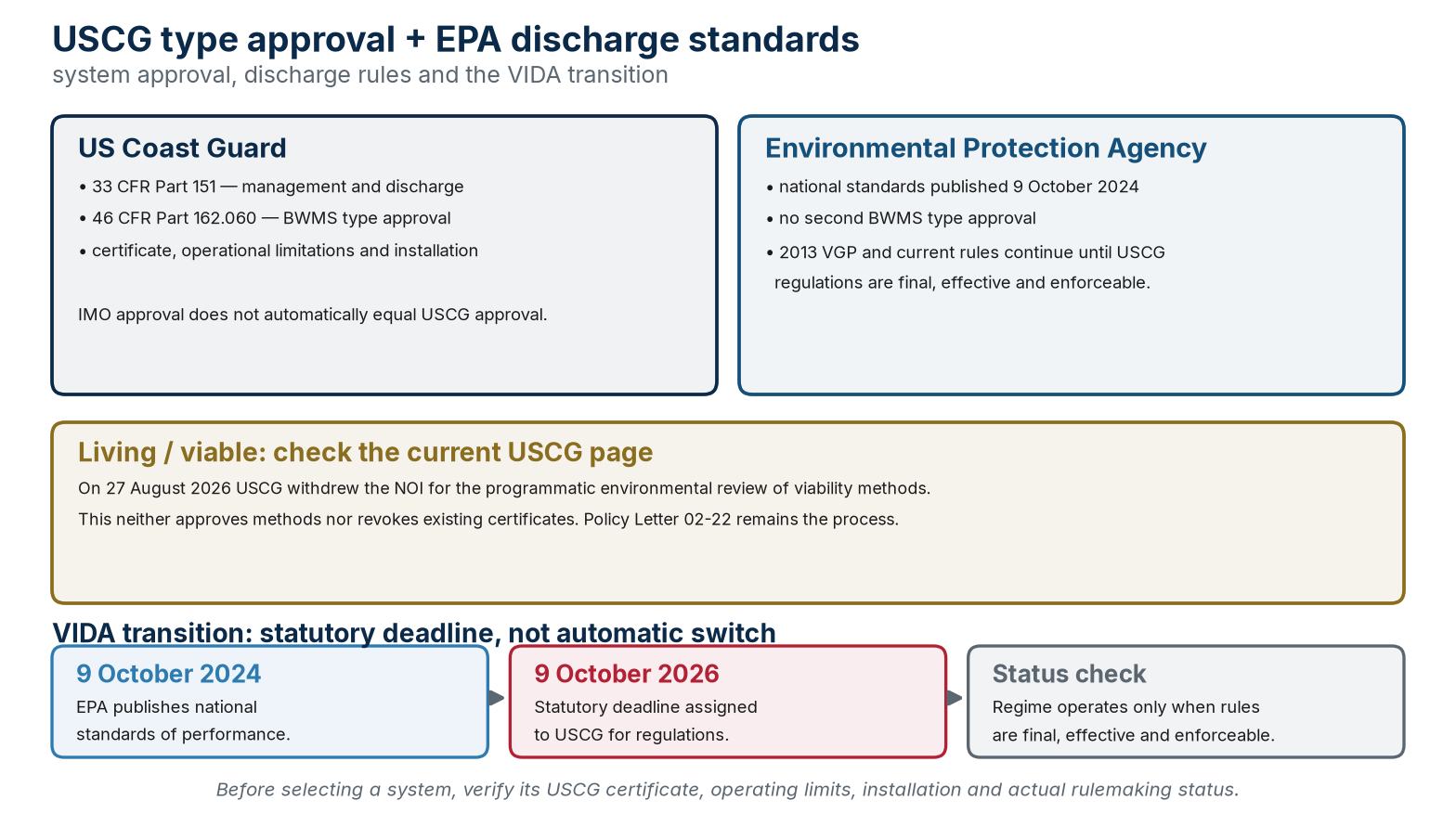
The United States is not a Party to the BWM Convention. Subject vessels operate under 33 CFR Part 151 and BWMS type approval under 46 CFR Part 162.060. IMO approval does not automatically equal USCG type approval: the US certificate, operational limitations and installation must be checked.
USCG type approval and testing methods
The historical distinction between “living” and “viable/capable of reproduction” remains relevant but should not be frozen at 2022. Policy Letter 02-22 defines an evaluation process, while USCG separately publishes testing methods and protocols accepted under VIDA. Current status must be checked before technical decisions; it is wrong to say UV systems generally lack US approval.
EPA discharge standards and VIDA transition
EPA published the Vessel Incidental Discharge National Standards of Performance on 9 October 2024. USCG implementation, compliance and enforcement regulations are to follow. Until those rules are final, effective and enforceable, the 2013 VGP, current USCG rules and applicable State and local requirements continue. 9 October 2026 is the statutory deadline assigned to USCG, not an automatic switch.
AMS is a transitional solution tied to the compliance date and approval of the individual ship and system; status must be checked from the actual documents.
Position at 15 September 2026: the 27 August 2026 Federal Register records withdrawal of the Notice of Intent for a programmatic environmental review of certain viability-testing methods because available information was insufficient. This neither generally approves methods nor automatically revokes existing BWMS certificates. Policy Letter 02-22 remains the process for potential future submissions. Check the USCG certificate, operating limits, AMS conditions and reporting/discharge duties separately. AMS permits temporary use within the allowed period relative to the ship’s compliance date; assume neither universal expiry nor unlimited validity. The EPA VIDA page confirms that transition requires final, effective and enforceable USCG rules.
Key takeaways
- An IMO-approved BWMS is not automatically USCG type approved.
- EPA sets discharge standards; USCG develops implementation, compliance and enforcement and administers type approval.
- Until the USCG VIDA rules are actually final, effective and enforceable, the 2013 VGP, existing USCG rules and other applicable requirements continue.
PSC inspections on ballast water
Module objectivePrepare operational evidence for the four PSC stages and interpret the 2025 CIC data with correct source attribution.
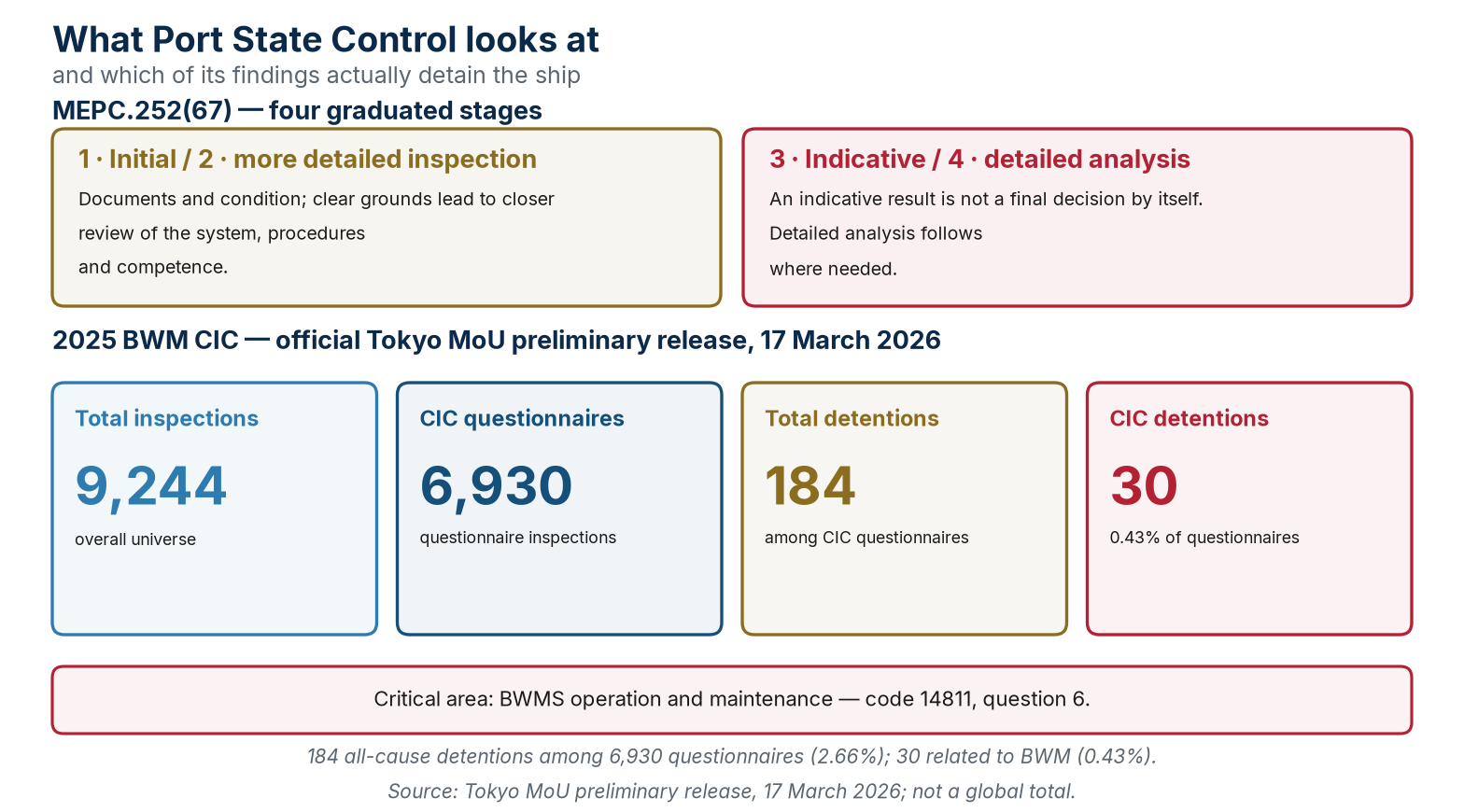
Guidelines MEPC.252(67) describe four graduated stages: initial inspection; more detailed inspection where clear grounds exist; sampling with indicative analysis; and detailed analysis where needed. An indicative result is not by itself a final determination of non-compliance.
Recurring controls
- Certificate, BWMP and BWRB consistent with ship, voyage and system.
- Operation, alarms, self-monitoring, maintenance records and commissioning.
- Actual crew knowledge of ship-specific procedures.
- Sampling, timing and action under the Guidelines and authority procedures, avoiding undue delay.
2025 BWM CIC: official preliminary data
| Indicator | Value |
|---|---|
| Total inspections | 9,244 |
| Inspections using the CIC questionnaire | 6,930 |
| Total detentions | 184 |
| Detentions directly resulting from CIC deficiencies | 30 — 0.43% of questionnaire inspections |
The critical area identified was BWMS operation and maintenance (code 14811, question 6). The data do not support undocumented regional rankings or further claims.
The 184 all-cause detentions concern inspections with a CIC questionnaire (184/6,930 = 2.66%); the 30 directly related to BWM represent 0.43% of that same denominator. Do not use 9,244 as denominator for these percentages. These figures are from the Tokyo MoU preliminary release of 17 March 2026, not a global total or a Tokyo/Paris sum.
Key takeaways
- Control progresses from documents and initial conditions to detailed inspection, indicative analysis and possible detailed analysis.
- Certificate, BWMP, BWRB, familiarisation, maintenance, alarms and physical configuration must describe the same operation.
- CIC data need source, universe and methodology; an external database must not be presented as an official MoU release.
Sediment management
Module objectiveApply regulation B-5 and G12 to prevention of accumulation, safe removal, recording and disposal of sediments.
Regulation B-5 requires sediments from spaces designated to carry ballast water to be removed and disposed of in accordance with the BWMP.
Design, removal and disposal
Ships constructed from 2009 to which the provision applies should, as far as practicable, minimise uptake and accumulation, facilitate removal and provide safe access, taking G12 into account.
Location and method depend on the approved plan, available reception facilities, safety procedures and applicable State or port rules. Regulation B-5 does not contain a universal geographical prohibition for every sediment and circumstance.
Entry into ballast tanks is enclosed-space work: apply risk assessment, isolation, permit, ventilation, atmosphere testing and rescue readiness under the SMS and applicable rules. Do not enter to remove sediments without these conditions. Agree reception, quantity and transfer arrangements with the facility and retain its receipt and records.
Key takeaways
- Sediments and ballast water are related but require distinct operating procedures.
- Removal and disposal follow the BWMP, ship conditions and facility/authority rules.
- Tank design, inspection, safe access and maintenance reduce accumulation and operational risk.
Crew training
Module objectiveDefine ship-specific familiarisation enabling crew to operate, recognise deviations, respond and record correctly.
As with the other management systems seen in previous courses, genuine compliance with the Convention depends on the crew's competence in correctly operating the system and completing the required documentation.
Elements of good training
- Understanding of the basic operation of the BWMS installed on board, not just start/stop procedures.
- Recognition of malfunction signals and immediate intervention procedures.
- Correct completion of the Record Book in real time, not after the fact.
A crew that can only start and stop the system, without understanding the correct operating parameters, is unable to promptly recognise a malfunction that could compromise D-2 compliance without anyone noticing until an inspection.
B-6 requires familiarity with assigned duties and the ship-specific plan; it does not itself create a separate universal BWM certificate. Verify practical competence in system limits, alarms, deviations and records through demonstrations and scenarios. Document initial familiarisation, personnel or system changes and updates; use a language understood by those involved.
Key takeaways
- Competence should reflect duty, BWMP, installed technology and system design limitations.
- Crew should interpret trends, alarms, bypass, neutralisation and CWQ conditions, not merely start and stop the system.
- Familiarisation, drills and response evidence should align with the SMS and the expected evolution of B-6.
Integrating BWM into the SMS, maintenance and voyage planning
Module objectiveIntegrate BWM with the SMS, planned maintenance, stability, voyage/cargo planning and energy management without conflating their legal bases.
The BWM Convention remains distinct from MARPOL, ISM, stability requirements and climate regimes. On board, however, their processes share people, machinery, data and decisions. The BWMP should interface with the SMS, planned maintenance, familiarisation, risk assessment, passage/voyage planning, cargo plan and emergency management.
Before, during and after the operation
Before: verify ballast quantities and sequence, stability and strength, BWMS flow and system design limitations, expected water quality, local restrictions, available time and contingency plan. During and after: monitor parameters, alarms, bypass, neutralisation, consumables, energy, samples and records; open defects/non-conformities and corrective action where needed.
BWMS electrical load may affect fuel and emissions, but this does not alter D-2 or turn BWM into a CII measure. Safety, biological compliance and energy performance remain distinct while their interactions are made visible.
Operational example: if turbid water reduces flow, reassess ballast time, cargo operations, stability and the port window together. Record the issue, consult the maker and authorities involved and apply the BWMP. Do not disable alarms or open bypass merely to meet the commercial schedule.
Key takeaways
- BWM remains distinct from MARPOL but shares people, data and processes with the SMS and maintenance.
- Ballast sequence, stability, BWMS flow, water quality and port time must be planned together.
- BWMS power demand may affect energy use, while safety, D-2 and carbon performance remain separate measures.
The review of the Convention: from MEPC 84 to MEPC 85
Module objectiveDistinguish instruments adopted at MEPC 84 from draft amendments expected at MEPC 85 and plan monitoring of entry into force.
MEPC 84 approved draft Convention amendments for expected adoption at MEPC 85; it did not make them mandatory. It adopted the 2026 G4 Guidelines through MEPC.409(84), inviting early application.
Dates, transitional provisions and final text must be verified after MEPC 85.
| Area | Draft change |
|---|---|
| A-3 / B-1 | CWQ, contingency, procedures and BWMS approval status in the plan. |
| B-2 / B-6 | Maintenance records and documented familiarisation. |
| D-2 | Maximum Allowable Discharge Concentration for active substances. |
| E-1 | Installation and maintenance records; annual residual sampling where applicable; biological testing at intermediate and renewal surveys to verify D-2, subject to adopted text. |
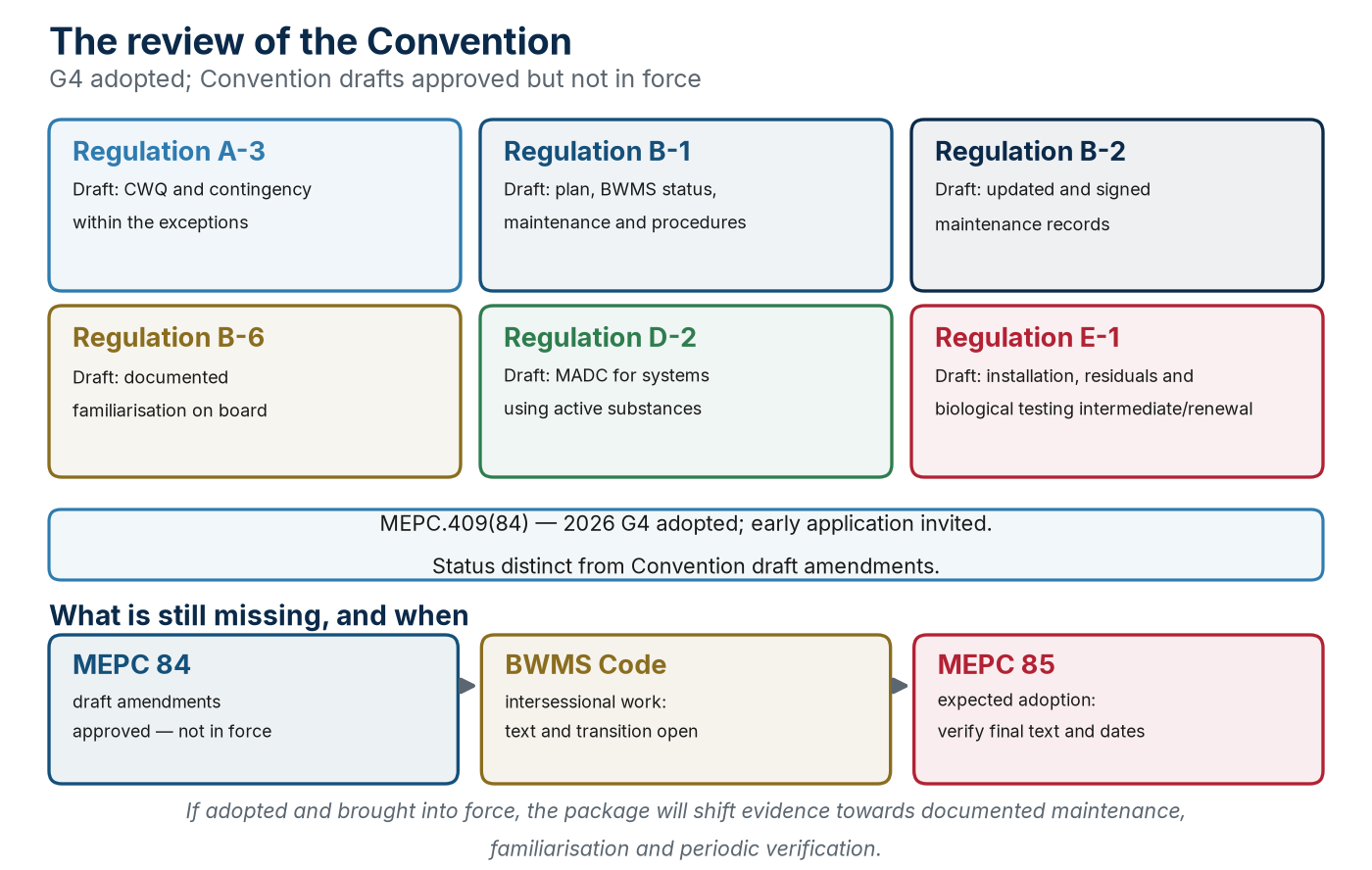
Work on the BWMS Code continues intersessionally. If adopted and brought into force, the package will shift evidence towards documented maintenance, familiarisation and periodic verification.
Status checked at 15 September 2026. Adoption of MEPC.409(84) does not bring the Convention amendments into force. The resolution invites early application of the new G4 and links revocation of the previous G4 to entry into force of the amendments. Agree plan updates with the flag. New periodic tests described in the draft are not presented here as Convention requirements already in force.
Key takeaways
- MEPC.409(84) adopted the 2026 G4 Guidelines; the Convention amendment package is only approved.
- The draft strengthens BWMPs, maintenance, familiarisation, active-substance residuals and periodic biological verification.
- Final text, transitional provisions and entry into force must be updated after MEPC 85.
Building effective BWM management
Module objectiveTranslate BWM obligations into fleet controls, responsibilities, evidence, escalation and continual improvement.
Effective management of BWM compliance requires the integration of equipment maintenance, documentary discipline and crew training, following the same principles already seen for the ISM Code and maintenance management.
Critical success factors
- Scheduled maintenance of the BWMS, with the same discipline seen in the Reliability Management course.
- Ongoing crew training, not limited to initial training alone.
- Rigorous discipline in completing the Record Book in real time.
- Monitoring of specific local requirements for the routes the ship usually serves.
Like decarbonisation and maintenance management, ballast water management is no longer an isolated obligation but an integrated component of the ship's daily technical management, requiring the same systematic attention given to other critical onboard systems.
For each anomaly assign an owner, action, deadline and closure evidence. Review recurring failures, CWQ operations, bypass, consumables, repair times and record discrepancies. Closure requires effectiveness verification, not merely a purchase order or spare-part receipt.
Key takeaways
- Effective management connects route intelligence, BWMP, PMS, spares/consumables, training and BWRB.
- Failures, bypass, contingencies and deficiencies should feed defect management, NC/CAPA and fleet trends.
- Useful KPIs measure reliability, deviations, record quality and action closure, not merely certificate presence.
Recurring mistakes
From the Mistake Library of SuperbaKnowledge, filtered to the subjects this course covers. This view selects and organises content published in SuperbaKnowledge; it does not modify or replace it. The linked Knowledge page remains the reference version, while official texts remain authoritative.
| Topic | Mistake | Typical consequence | Topic sheet |
|---|---|---|---|
| Ballast Water | Using the old BWRB format after 1 February 2025 | PSC deficiency | See the topic sheet |
Related PSC deficiencies
From the PSC Knowledge Base of SuperbaKnowledge. This view selects and organises content published in SuperbaKnowledge; it does not modify or replace it. The linked Knowledge page remains the reference version, while official texts remain authoritative.
| Deficiency | Regulation | Indicative frequency | Possible consequence | Topic sheet |
|---|---|---|---|---|
| Ballast Water Record Book format not updated (post 1/2/2025) | BWM Convention | Medium | Deficiency | See the topic sheet |
Glossary of acronyms
| Acronym | Definition |
|---|---|
| BWM | Ballast Water Management |
| BWMC | Ballast Water Management Convention |
| BWMP | Ballast Water Management Plan |
| BWMS | Ballast Water Management System |
| AMS | Alternate Management System (transitional USCG regime) |
| BWMS Code | Code for Approval of Ballast Water Management Systems (MEPC.300(72)) |
| CIC | Concentrated Inspection Campaign |
| EPA | Environmental Protection Agency (United States) |
| cfu | Colony-forming unit |
| GT | Gross Tonnage |
| IOPP | International Oil Pollution Prevention Certificate |
| MEPC | IMO Marine Environment Protection Committee |
| MADC | Maximum Allowable Discharge Concentration |
| MoU | Memorandum of Understanding on Port State Control |
| PSC | Port State Control |
| USCG | United States Coast Guard |
| VGP | Vessel General Permit (EPA) |
| VIDA | Vessel Incidental Discharge Act, 2018 |
References and sources
Checked at 15 September 2026. Official sources for status and applicability:
- IMO — BWM Convention and Guidelines
- IMO — MEPC 84 outcomes
- EPA — VIDA status
- USCG — notice 27 August 2026 (official PDF)
- Tokyo MoU — CIC 2025, 17 March 2026
Consolidated list of the sources cited. Updated as of September 2026.
| Function | Sources |
|---|---|
| Convention and application | 2004 BWM Convention; Article 3; Regulations A–E; current status to be checked against IMO treaty status. |
| Standards and timetable | Regulations B-3/B-4, D-1/D-2; MEPC.297(72). |
| Type approval and commissioning | MEPC.296(72), MEPC.300(72), MEPC.325(75), BWM.2/Circ.70/Rev.1. |
| Contingency and CWQ | BWM.2/Circ.62; MEPC.387(81). They are distinct instruments. |
| Records | MEPC.369(80), BWM.2/Circ.80/Rev.1; MEPC.383(81) and MEPC.372(80) for the electronic BWRB. |
| PSC and CIC | MEPC.252(67), BWM.2/Circ.42/Rev.2; Tokyo MoU preliminary CIC release, 17 March 2026. |
| United States | 33 CFR Part 151; 46 CFR Part 162.060; USCG Policy Letter 02-22 and current accepted-methods page; VIDA; EPA national standards. |
| 2026 review | MEPC.409(84): 2026 G4 adopted. Convention drafts approved at MEPC 84, not in force; adoption expected at MEPC 85. |
This course is educational material for training purposes and does not constitute a professional certification or qualifying credential. Read the full disclaimer.